Get Full Government Meeting Transcripts, Videos, & Alerts Forever!
Get email alerts on the Economic Development topic
No spam. Unsubscribe anytime.
San Francisco committee hears evidence that biotech payroll exclusion helped build local cluster; forwards measure to full board without recommendation
Summary
A Board of Supervisors subcommittee heard a city report and broad public testimony supporting an amendment to allow rolling 7.5-year biotech payroll tax exclusions and tighten the definition of "biotechnology." The committee forwarded the ordinance to the full board without a recommendation after extensive questions about local hiring and fiscal impact.
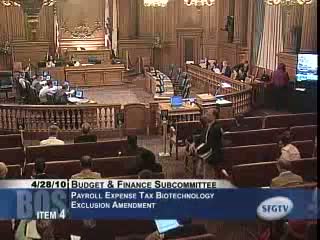
The Budget and Finance Subcommittee on April 20 considered an ordinance that would amend section 906.1 of the San Francisco Business and Tax Regulations Code to clarify what counts as a biotechnology firm and to let eligible companies claim a 7.5-year payroll-tax exclusion regardless of their application date. Supervisor Adelita Alioto Pier, the item sponsor, said the change would make the exemption a "rolling sunset" and require sign-off by the Department of Public Health on applications.
Ted Egan of the Controller's Office summarized the five-year evaluation required by the 2004 ordinance, reporting that San Francisco's share of Bay Area biotechnology employment rose substantially since 2004 and that the city has seen about 2,250 biotech jobs created that the city links to the cluster expansion. Egan and the budget analyst emphasized the difficulty of isolating the precise effect of the payroll exclusion from other factors, including private-sector lab construction and Mission Bay development. The budget analyst reported that eligible businesses paid about $265,203 in property taxes and that the total payroll-tax exclusions awarded between 2004 and 2008 amounted to roughly $963,396.
City staff and industry speakers said the credit played a role beyond the direct number of firms claiming it. Jennifer Matz of the Office of Economic and Workforce Development and representatives from BayBio, QB3 and local firms described low vacancy in built lab space, a pipeline of City College and SF State trainees into local biotech jobs, and the payroll exclusion as part of a package of incentives that signals the city's intention to attract life-science tenants. FibroGen and other employers said the credit factored into relocation decisions and that their operations have yielded construction and local-service jobs.
Supervisors asked how many jobs went to San Francisco residents, whether FirstSource enforcement in Mission Bay is achieving local-hire goals, and what the vacancy rates are for lab and shell space. Staff said FirstSource conditions apply to Mission Bay leases but acknowledged they do not yet have comprehensive, citywide residency tracking for all biotech hires and agreed to supply additional data before a full-board vote.
Public testimony included students and educators describing biotech workforce pipelines at City College and Lincoln High School and industry representatives citing the sector's broader benefits. Department of Public Health Director Mich Katz said the department can assist in defining a scientifically accurate definition of biotechnology to limit the exclusion to appropriate firms.
Procedural outcome: the committee voted to forward the ordinance to the full Board of Supervisors without a committee recommendation, leaving final policy and fiscal trade-offs to the full board. No vote on final adoption was taken at the subcommittee.
What's next: the measure will be scheduled for a full Board hearing. Staff said they would provide the additional local-hire and FirstSource compliance numbers requested by supervisors before that meeting.
Sources: Committee presentations and public testimony at the Budget & Finance Subcommittee hearing on April 20; Controller's summary of payroll-tax exclusion impacts; public comments from City College, industry groups and firms.