Get Full Government Meeting Transcripts, Videos, & Alerts Forever!
Get email alerts on the Committee Actions topic
No spam. Unsubscribe anytime.
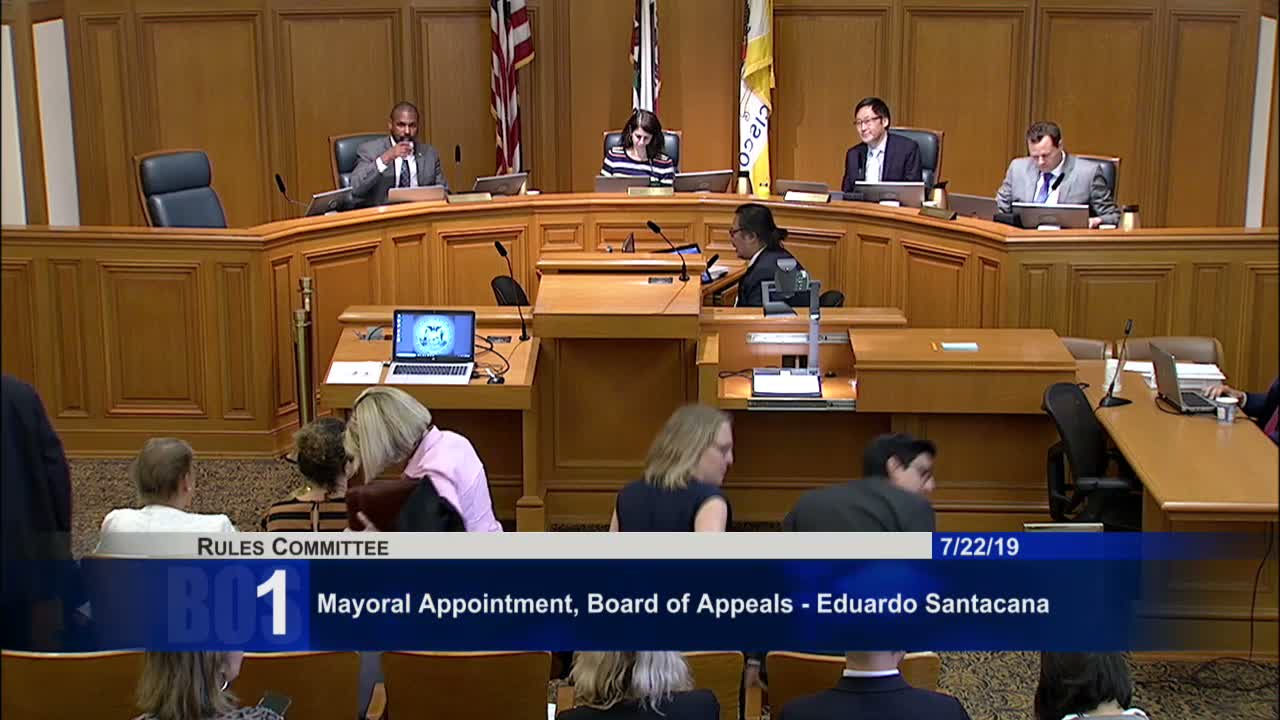
Rules Committee advances several measures: ballot committee appointments, small-business working group, housing loan delegation; bond item tabled
Summary
The committee advanced appointments to the Ballot Simplification Committee and a small-business mitigation resolution, approved an ordinance to delegate certain affordable-housing loan approvals to the Mayor’s housing office, and tabled a proposed $600 million bond ballot ordinance.
At its July 22 meeting the Rules Committee moved multiple administrative and policy items to the full Board of Supervisors or otherwise resolved next steps.
Ballot Simplification Committee appointments: The committee heard short remarks from nominees Betty Packard and Ashley Raviche and moved Scott Patterson, Betty Packard and Ashley Raviche forward to the full Board with a positive recommendation. Betty Packard described decades of involvement with ballot-question work and said the panel helps ensure ballot language is understandable to voters.
Small-business mitigation: Supervisor Shamone Walton introduced a resolution urging the Office of Small Business and the Small Business Commission to convene a working group to design economic-mitigation measures for retailers affected by recent legislation. Dominica Donovan of the Small Business Commission thanked supervisors for collaborating; the item was referred to the full Board as a committee report by unanimous consent.
Housing loan-delegation ordinance: Kate Hartley, director of the Mayor's Office of Housing and Community Development, asked the committee to delegate authority for three loan types to speed up time-sensitive transactions: loans under $10 million with long terms (e.g., small-sites acquisitions), local operating subsidy program grants (which will still require annual appropriations), and rare emergency loans that could exceed $10 million to prevent loss of housing. Jonah Lee (MOHCD) said roughly 10 small-sites projects have been brought through the process and managing approvals under delegated authority had enabled timely closings; the committee sent the ordinance forward as a committee report.
General obligation bond ballot question: The mayor’s office asked the committee to table an ordinance that would authorize the controller to modify ballot questions for a proposed $600 million general obligation bond for affordable housing because a pending state bill (SB 268) will not take effect in time for the November ballot. The committee voted to table the item unanimously; it will return when state timing or text warrants.
Public commenters at several items raised concerns about whether city affordability thresholds and program eligibility sufficiently include the most vulnerable residents; those concerns were recorded in public comment but did not change committee referrals.
All referrals and motions at the meeting were taken by unanimous consent where recorded and will appear on subsequent Board agendas per the clerk’s announcement.