Get Full Government Meeting Transcripts, Videos, & Alerts Forever!
Get email alerts on the Charter Amendment topic
No spam. Unsubscribe anytime.
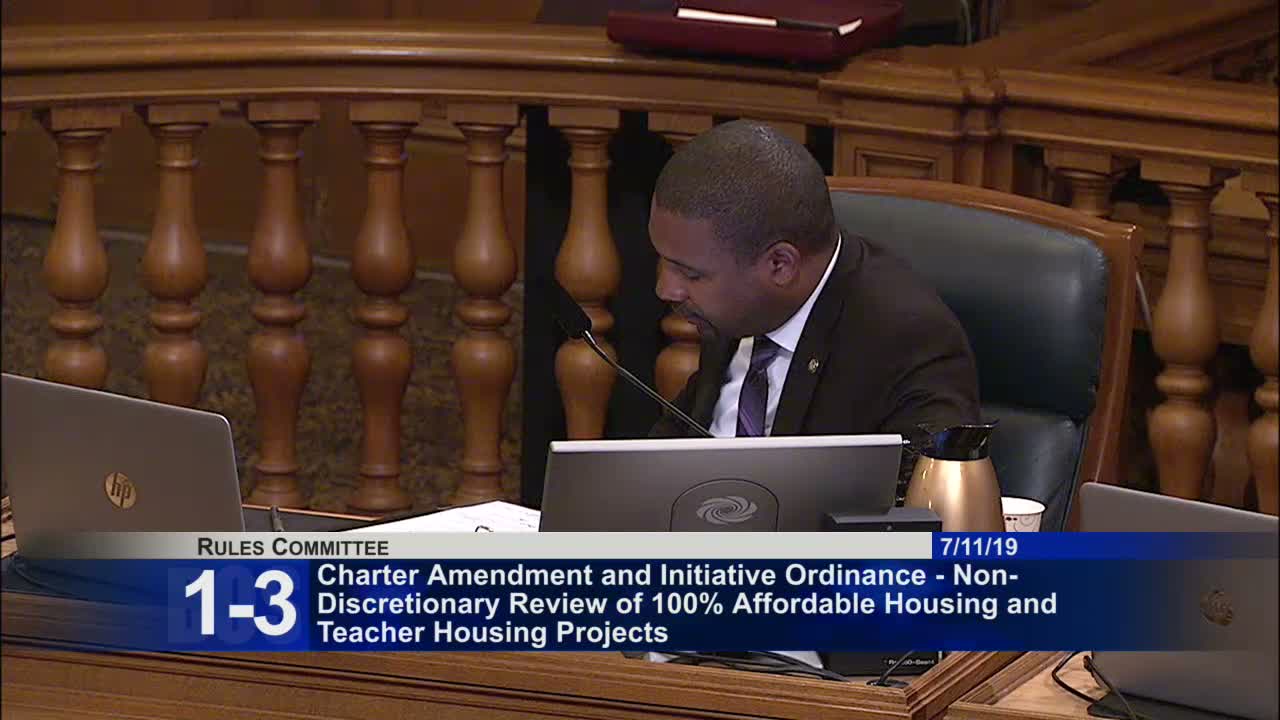
Committee tables mayor's charter amendment after divided testimony; supervisors call for more negotiation
Summary
The Rules Committee tabled the mayor's proposed charter amendment to streamline affordable and educator housing review after extensive testimony and questions about AMI levels and use of public land; supervisors asked for further amendments and stakeholder talks.
The Rules Committee on July 11 tabled the mayor's charter amendment that would alter the city charter to permit ministerial approval for certain affordable and educator housing projects and to define eligibility and AMI thresholds.
Supervisor Walton moved to table item 3 for additional negotiation between the board and the mayor's office; the motion passed by unanimous consent of present committee members. Chair Ronan framed the move as a practical step given that a quorum of supervisors expressed concerns and that the board and mayor need to coordinate to maximize passage of the housing bond and any ballot measure.
Opponents of a charter amendment as written stressed that putting definitions into the charter risks making the rules inflexible. Supporters of the mayor's approach argued that removing discretionary appeals for affordable housing is essential to speed delivery.
Andres Power (mayor's office) offered several potential fixes, including deleting the teacher-housing definition from the charter and allowing the board later to define it by ordinance, and limiting by-right treatment for a narrow set of historic-preservation cases.
By tabling the charter amendment, the committee left open further negotiation and directed staff and stakeholders to reconvene on language that could address concerns about AMI levels, scope on public land, and historic-preservation review.