Get Full Government Meeting Transcripts, Videos, & Alerts Forever!
Get email alerts on the Mayor Initiative topic
No spam. Unsubscribe anytime.
Mayor's housing amendment pitched as speed tool; supervisors and unions raise concerns about AMI and public land
Summary
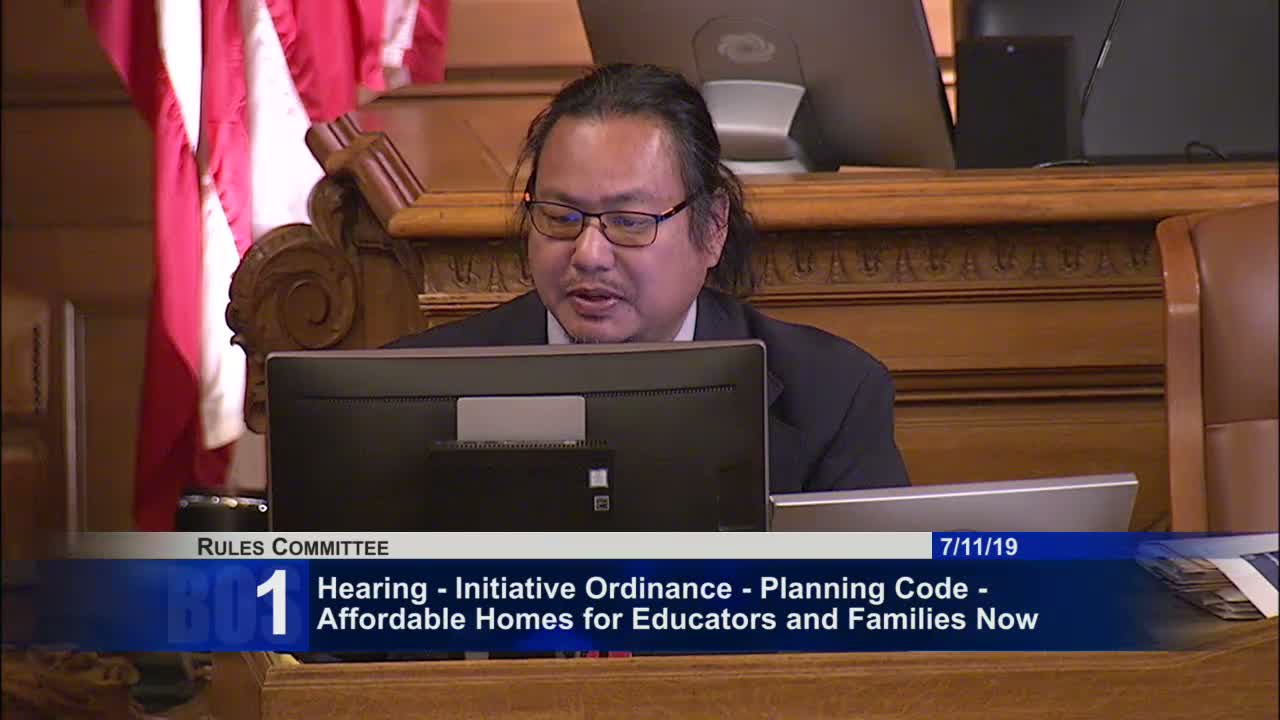
The mayor's charter amendment and companion initiative would permit by-right approvals for certain affordable and educator projects and raise some AMI thresholds. The mayor's office argued streamlining reduces cost and delay; several supervisors and unions said the charter risks locking a higher affordability definition into the city constitution.
Representatives of the Mayor's Office of Housing and Community Development argued the mayor's charter amendment and initiative are designed to reduce lengthy discretionary review and accelerate construction of 100% affordable and educator housing.
Kate Hartley, director of MOHCD, told the committee discretionary review often adds years and significant extra costs: "If we're delayed 2 years in an iterative, discretionary review process, and we have a $100,000,000 construction budget, that's a $12,000,000 additional cost to our projects," she said.
The mayor's initiative would define a broader range of AMI for affordability, allow educator housing with up to one-third market-rate units in some configurations, and permit such housing in more zoning districts (with exceptions such as RH1 and certain public-park and landmark sites). The mayor's office said the package is additive to existing affordable-housing tools.
Opponents, including Supervisor Feuer and several union and tenant representatives, warned that embedding definitions in the charter is risky. "The charter amendment will actually redefine affordable housing to raise income levels to 140% of AMI," Supervisor Feuer said during opening remarks, arguing that a charter change would be difficult to reverse and could leave low-income households behind.
Andres Power of the mayor's office proposed committee amendments intended to address teacher-housing definition concerns: remove the teacher-housing definition from the charter and allow the board later to define teacher housing by ordinance, and preserve historic-preservation jurisdiction for a small subset of projects.
Public testimony was split. Housing advocates, YIMBY groups and some residents urged removing discretionary appeals and putting the mayor's charter amendment on the ballot, saying streamlining is essential to speed production. Several education-union speakers and supporters of the board measure opposed the charter amendment as drafted and urged retaining public-review safeguards and deeper affordability on public land.
Outcome at committee: the mayor's initiative was heard and filed together with the board's ordinance; the charter amendment (item 3) was tabled for further work and amendment.