Get Full Government Meeting Transcripts, Videos, & Alerts Forever!
Get email alerts on the SOS Program topic
No spam. Unsubscribe anytime.
Rules Committee recommends $5 million senior operating subsidy pilot to make new senior units affordable
Summary
The committee unanimously recommended an ordinance to create a Senior Operating Subsidy (SOS) fund—$5 million over five years—to subsidize operating costs at new senior affordable housing projects so extremely low-income seniors can qualify; supervisors added amendments on funding continuity, transition reserves, and reporting.
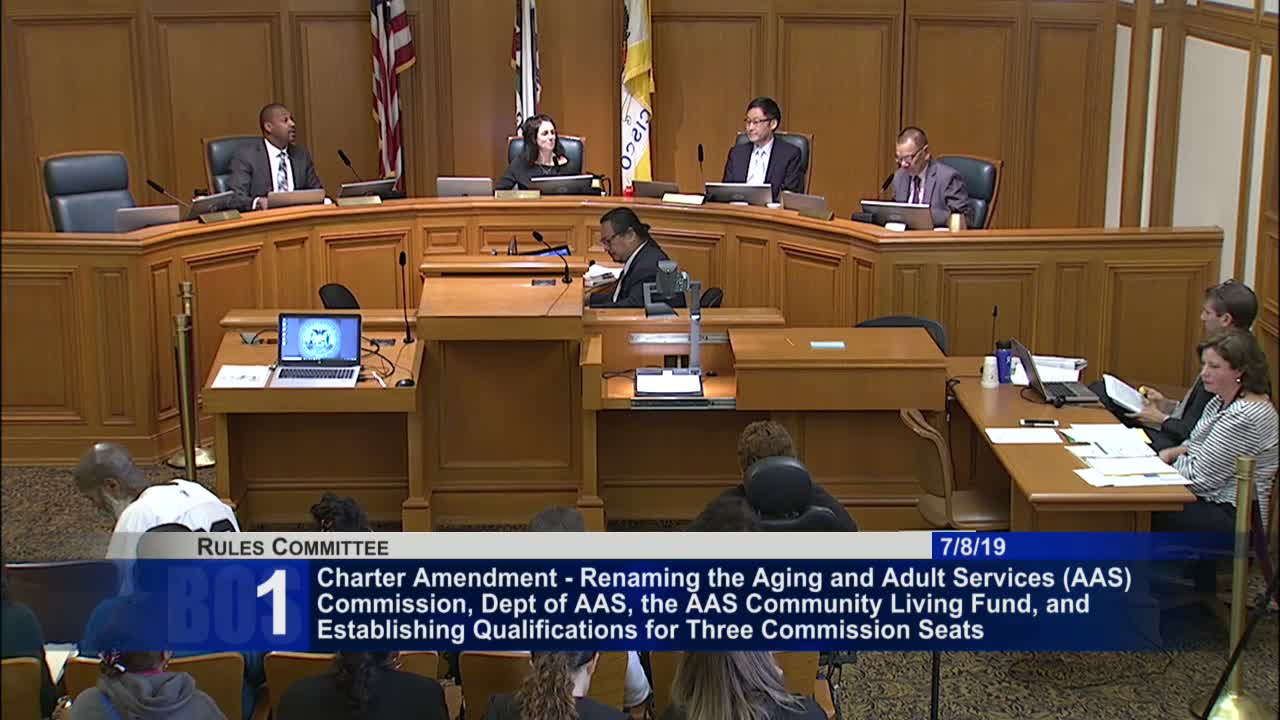
The Rules Committee on July 8 forwarded an ordinance to create a Senior Operating Subsidy (SOS) fund to the full Board with a positive recommendation as amended. The package, introduced by Board President Norman Yee, is a pilot program to lower rents at city-funded senior developments so seniors on fixed incomes can qualify for units that otherwise would be priced at 50% AMI.
Yee described the action as an urgent, targeted fix to a gap in senior affordable housing financing: federal operating subsidies (HUD Section 202) ended in 2011, leaving new senior housing without ongoing operating funds that keep rents affordable for extremely low-income seniors. The ordinance as introduced sets aside $5,000,000 over five years for project-based operating subsidies and includes provisions to allow the fund to support transition reserves and, if unused within five years, to convert to tenant-based subsidies.
Yee proposed four amendments adopted by the committee: an explicit statement of the city's intent to continue annual funding for projects receiving SOS subsidies; authority to use SOS funds for transition reserves to protect projects if subsidies stop; a five-year time limit after which unencumbered funds may be used for tenant-based subsidies; and a distribution requirement to spread subsidies across multiple projects rather than a single site.
Public testimony included partners developing Casa Adelante (1296 Shotwell) and advocacy groups who urged that the pilot be used across several projects and that the program enable rents for extremely low-income seniors (15%–25% AMI). Chinatown CDC testified that operating costs for their new building are roughly $857 per unit per month and said SOS could enable serving a broader range of low-income seniors. Advocates urged annual reporting to the Board and Mayor and a plan to scale the program beyond the initial pilot.
Chair Ronan called the motion to recommend the ordinance as amended; the committee accepted the amendments without objection and passed the recommendation unanimously.
The ordinance will now go to the Board of Supervisors for consideration. If approved, implementation details (administration, project selection, and reporting) will be handled by the relevant city departments and participating developers.