Get Full Government Meeting Transcripts, Videos, & Alerts Forever!
Get email alerts on the General Fund Deficit topic
No spam. Unsubscribe anytime.
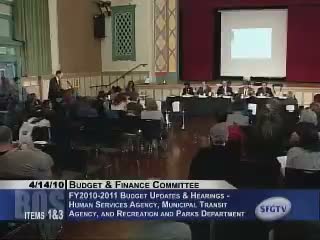
Supervisors hear plans to close nearly $483 million general fund gap; HSA, Rec & Park propose cuts and revenue strategies
Summary
Mayor’s budget office briefed the committee on a roughly $483 million general fund deficit and suggested a mix of one‑time and ongoing measures; Human Services and Recreation & Park outlined program adjustments, JobsNow expansion, an IHSS premium proposal, and revenue‑forward approaches that drew strong community comment urging protection of frontline services.
The mayor’s budget team told the Board of Supervisors’ Budget & Finance Committee that the city faces a projected general fund shortfall of about $482.7 million and plans to use a combination of one‑time measures and department proposals to narrow the gap. "We have a $482,700,000 general fund deficit currently projected," Greg Wagner, the mayor’s budget director, said, summarizing revenue losses and rising salary and benefit costs as core drivers of the shortfall.
Wagner outlined a menu of responses: avoiding contractual inflation adjustments, labor concessions (including furlough proposals), exercising the Prop H charter trigger to defer some payments to schools/First 5, capital project deferrals, and efforts to increase health‑related revenues. He and supervisors stressed that most of the listed solutions are one‑time or temporary and urged work toward ongoing structural solutions to avoid worse deficits in subsequent years.
Trent Rohrer, director of the Human Services Agency, detailed HSA’s FY2011 proposal and the ways federal and state dollars are being used to meet department targets. HSA proposed using federal stimulus and Medicaid waiver match funding to cover some costs, expansion of the JobsNow wage program (planned funding around $62 million for next year), and programmatic tradeoffs tied to expiring grants. Rohrer also described a proposed increase in the IHSS health premium for providers (from $3 to $25 per month) as a local revenue source the department had considered.
The Rec & Park Department presented a revenue‑heavy approach to a $12.4 million shortfall. General Manager Phil Ginsberg said the department sought to generate most of the savings through new concessions, expanded programming, and partnerships rather than across‑the‑board fee increases or service eliminations. Proposed measures include food/amenity concessions in parks, nonresident admission fees at specialty sites (for example, the Botanical Garden), expanded special events, an apprenticeship program to lower labor costs over time, and a $250,000 youth scholarship fund to preserve access for low‑income children.
Public comment was extensive and largely focused on frontline impacts. Home‑care providers, public clinic workers and community groups warned that repeated cuts have already reduced service access and urged the Board to prioritize progressive revenue options (transfer taxes, gross receipts, hotel tax increases) rather than deeper program reductions. Rec & Park staff and neighborhood advocates split public reaction: some welcomed the department’s revenue focus and recreation restructuring as necessary to preserve services; others urged scrutiny of proposals such as Sharp Park golf course operations and cautioned that nonresident fees could become mandatory resident fees.
Controller Ben Rosenfield said his office would complete a review of MTA work orders within the coming week and that the mayor’s office and departments were coordinating on revenue and expenditure reductions. Supervisors asked for more transparent, itemized budgets and follow‑up materials to understand the long‑term effects of proposed one‑time fixes.
No formal budget adoption occurred at the hearing; supervisors framed the neighborhood session as an input step ahead of the mayor’s June 1 submission of a balanced budget and subsequent deliberations by the Board.