Get Full Government Meeting Transcripts, Videos, & Alerts Forever!
Get email alerts on the Transit Budget topic
No spam. Unsubscribe anytime.
MTA says state’s $36 million will shore up next year’s budget but not avert May 1 service reductions
Summary
MTA Director Nat Ford told the Board that recently announced state transit funds of $36 million will be applied to next year’s budget and are insufficient to undo a planned 10% reduction in Muni service slated for May 1; supervisors pressed MTA on work orders, a $12.5 million police contract and possible revenue measures.
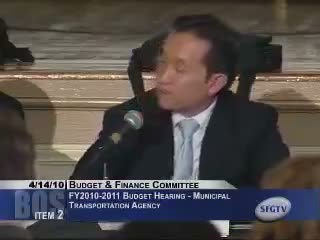
The Municipal Transportation Agency plans to carry out a 10% reduction in Muni service beginning May 1 while using a newly announced $36 million in state transit aid to stabilize the system in the following fiscal year, MTA Director Nat Ford told the Board of Supervisors’ Budget & Finance Committee. "It will be a smaller system, but it will be a well maintained and better managed system in terms of its size," Ford said in opening remarks about the agency’s two‑year budget.
Ford described a multi‑year erosion of state transit assistance that left MTA with large structural deficits. He said the agency’s FY2011 gap is roughly $80–84 million and that the $36 million is not available to advance into the current year: "It will be going solely into next year's budget," he said, adding that the MTA expects to use the funding and other measures to produce a small surplus in FY2012.
Supervisors repeatedly pushed Ford on whether the state money could roll back the May 1 cuts. Board President David Chu said many riders had hoped the $36 million would restore service. "Could you talk about that, as well as talk about the underlying projections for why you think you can't project a rosier future in '12?" Chu asked. Ford replied that while the funding helps prevent deeper cuts or additional fare increases, it is "not enough to, to totally wipe out the 10% modification we need to make." He said some mitigation options — a short delay of cuts or partial adjustments to night‑owl headways — would only postpone a larger out‑year shortfall.
The MTA described the 10% reduction as an average across the system, not uniformly applied: Ford said the agency relied on its Transit Effectiveness Project data to minimize changes on the busiest corridors and that some lines will see deeper reductions while heavy corridors will be partially protected. He also said the MTA will monitor headways and crowding and make midyear adjustments if necessary.
Supervisors pressed the agency to identify additional revenue sources. Ford said the MTA board is evaluating about six revenue measures for possible placement before voters in November and noted the difference in thresholds: a measure originating with the MTA board requires a two‑thirds approval of voters, while placement via the Board of Supervisors would require a simple majority to qualify for the ballot.
Work orders and interdepartmental charges were another focus. Ford said the FY2011 budget recognizes a 10% reduction in work orders (from roughly $69 million to about $63 million) but that those cuts require negotiation with receiving departments. Asked about a roughly $12.5 million annual work order paid to SFPD for transit policing, Ford said dedicated Muni policing has been a long‑standing practice and acknowledged the Board’s request for a line‑by‑line accounting. "We have 12 dedicated officers as well as…district captains supplementing that with patrols on Muni," he said.
Fare enforcement practices and community concerns about intimidation also came up during public comment. Community members from Chinatown and the Mission described instances where fare checks coupled with police presence felt intimidating for non‑English speakers. Ford acknowledged the concerns and said the MTA and SFPD agreed to review deployments, increase cultural‑competency training and ensure multilingual officers or fare inspectors are present during targeted operations.
On capital projects, Ford told supervisors that funds committed to the Central Subway project are largely federal and matched with local capital and therefore cannot be repurposed for operations. "Those capital funds cannot be reallocated to our operating budget," he said, warning that delaying the project could risk the federal match moving elsewhere.
The MTA said it will provide more detailed accounting in the coming days and will continue to brief the Board as the agency finalizes the FY2011 budget. The public and supervisors urged faster and clearer explanations of how work orders, police contracts and potential ballot measures factor into both short‑term mitigation and long‑term fiscal stability.
The committee did not take any vote on the MTA budget at the hearing; the MTA board is expected to act on a balanced budget on Tuesday and will forward materials to the Board of Supervisors for formal review in May.