Get Full Government Meeting Transcripts, Videos, & Alerts Forever!
Get email alerts on the Mills Act Townsend topic
No spam. Unsubscribe anytime.
Supervisors table Mills Act designation for 166–178 Townsend after debate over tax break and financing
Summary
The committee heard valuations and tax-impact scenarios for a proposed Mills Act contract at 166–178 Townsend Street, debated the project's reliance on Mills Act assumptions for HUD financing, and voted 2–1 to table the Mills Act designation amid concerns about delinquent property taxes and the long-term cost of the tax reduction (~$62,296 annually).
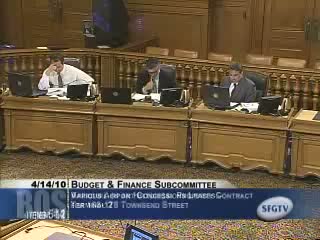
The Budget and Finance Committee on Item 14 considered a proposed Mills Act historical-property contract for 166–178 Townsend Street and voted to table the designation after extended discussion about tax consequences, financing and precedent.
Planning Department representative Tara Sullivan described three valuation methodologies prepared with the Assessor’s Office and emphasized the program’s intent to incentivize preservation and maintenance. Assessor Matthew Thomas presented the numbers: an existing assessed value of roughly $3.8 million, a projected market value after redevelopment of about $31.5 million, and Mills Act scenarios that yield estimated annual property-tax reductions ranging from roughly $52,000 to $62,296 depending on the valuation method.
The budget analyst noted the Board previously authorized $33 million in ABAG tax-exempt bonds tied to the project’s financing and recommended the Planning Department submit formal programmatic guidelines to the Board so future Mills Act applications are governed by clear criteria. The analyst also recommended that because this application predated the proposed administrative guidelines (filed Feb. 2009), it be considered under the prior informal criteria.
The property owner’s representative said the Mills Act inclusion had been factored into appraisals used to secure HUD financing and that without it the project would face a funding shortfall, potentially making the project unworkable 'for the foreseeable future.' The representative described the development as all-union, all-rental, with 20% of units at 30% AMI.
Supervisors raised concerns about the owner’s history of delinquent property taxes, the prospect of an ongoing annual general-fund subsidy in perpetuity if the contract automatically renews, and whether the Mills Act’s intended use (to enable preservation) is being stretched for a project with sizable new construction elements. Following debate, a motion to table the item passed on roll call (Supervisor Mercurini — yes; Supervisor Ellsburn — no; Supervisor Avalos — yes). The Clerk announced the item was tabled.