Get Full Government Meeting Transcripts, Videos, & Alerts Forever!
Get email alerts on the Medical Cannabis Regulation topic
No spam. Unsubscribe anytime.
City holds broad oversight hearing on state medical-cannabis law, seeks local permitting path
Summary
Supervisors heard presentations from DPH, Planning and DBI on the state Medical Marijuana Regulation and Safety Act'and the need to create local permitting and zoning for cultivation, manufacturing, testing and delivery; industry speakers urged clear local rules, equity provisions and fast action ahead of the state's 2018 licensing deadlines.
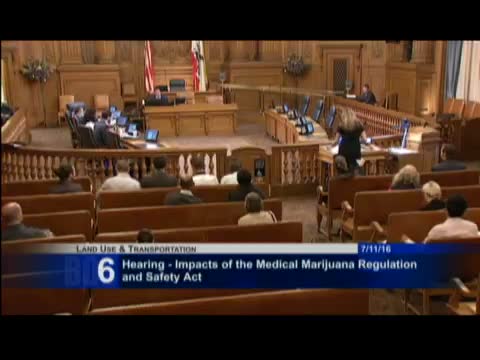
Supervisor Scott Wiener convened a committee oversight hearing on state medical-cannabis legislation and its implications for San Francisco's local rules. Cindy Comerford of the Department of Public Health summarized the new state framework, noting it creates a dual state-local licensing system with roughly 17 license types (dispensaries, cultivation, manufacturing, distribution, transport and testing) and that San Francisco currently issues a single retail dispensary permit. "The new law allows for some limited type of vertical integration...the local authority in this new law is rather broad," Comerford said, stressing the city must decide which license types it will allow locally.
Aaron Starr of the Planning Department recommended two initial steps: adopt earlier Planning Department recommendations on medical cannabis dispensaries and amend planning-code definitions for agriculture and manufacturing to align with the state's new license classifications. Starr flagged the clustering problem stemming from the city's existing 1,000-foot buffer around schools and suggested options including shrinking the buffer to the state standard of 600 feet, permitting MCDs in more zoning districts, or adding anti-clustering provisions.
Representatives from the Department of Building Inspection described building-occupancy implications for cultivation and extraction facilities (F1 occupancy for many grow and extraction operations, H3 for combustible hazards) and noted permit routing through planning, DBI, fire and other agencies.
Industry and community witnesses urged San Francisco to create a clear local permitting pathway for non-retail license types before the state's licensing window begins (the state gave a target of 01/01/2018 for dual-license applications). Growers, manufacturers and patient advocates emphasized equity measures and the need to bring shadow operations into compliance. Terrence Allen, representing growers, said San Francisco should "create a corresponding local approval process and activate the non-retail side of cannabis businesses where they are appropriate," warning that unclear local rules could push businesses out of the city.
Committee action and next steps: Supervisor Wiener moved to file the item; the hearing record and staff recommendations will inform local legislation and the city's participation in state rulemaking processes. Departments emphasized the need to coordinate across DPH, Planning and DBI and to consider equity mechanisms like those adopted in Oakland.
Why it matters: The state law restructures cannabis licensing and requires local jurisdictions to decide which non-retail operations they will permit; those choices will affect local zoning, public safety code compliance, tax policy and workforce opportunities. San Francisco stakeholders highlighted both economic-development and social-justice considerations.