Get Full Government Meeting Transcripts, Videos, & Alerts Forever!
Get email alerts on the Housing Conservatorship topic
No spam. Unsubscribe anytime.
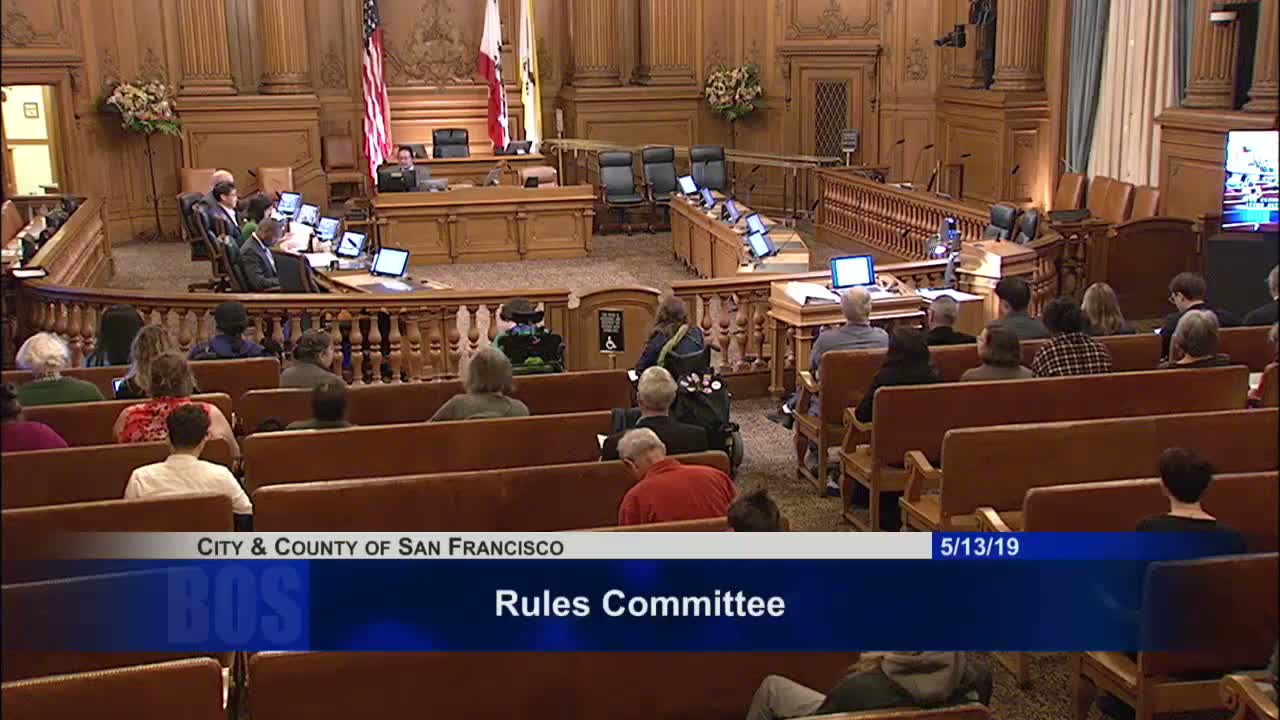
Rules Committee hears wide-ranging debate on SB 10‑45 housing conservatorship; continues item for more information
Summary
The San Francisco Rules Committee heard presentations and extensive public comment on local implementation of SB 10‑45, a five‑year pilot to permit temporary housing conservatorships for a very small, high‑need group. Supervisors pressed departments on bed capacity, due process and racial equity and continued the matter to May 20 for follow‑up.
San Francisco Chair Supervisor Hillary Ronan convened the Rules Committee on May 13 to hear Item 1, a staff presentation on local implementation resources for SB 10‑45, and Item 2, an ordinance to amend the health code to authorize housing conservatorship procedures and establish an implementation working group.
Supervisor Rafael Mandelmann, sponsor of the local ordinance, told the committee the state law creates a limited, five‑year pilot allowing counties to seek temporary conservatorships for people with co‑occurring serious mental illness and substance use disorder who repeatedly require involuntary psychiatric holds. Mandelmann said the pool is small — ‘‘estimates are that the law is likely to apply to fewer than 10 people a year’’ — and urged the committee to forward the ordinance with a positive recommendation or without recommendation so the full Board could debate it.
Department of Public Health and Conservator staff outlined how the housing conservatorship would work in practice. Dr. Angelica Almeida and Jill Nielsen described a composite client they called "Melanie," who stabilizes while on short hospital holds but repeatedly refuses voluntary services and then relapses. Staff said SB 10‑45 would add a narrowly targeted tool, tied to multiple objective and subjective tests (including at least eight 5150 involuntary holds in 12 months), to permit court‑ordered conservatorship only after less‑restrictive alternatives are tried. DPH presented data saying roughly 55 people meet the statute's eligibility criteria now, while acknowledging that many fewer would actually be conserved in a given year.
Simon Pang of EMS 6 gave frontline testimony about frequent 911 users who repeatedly refuse care, describing cases in which repeated emergency responses did not prevent deterioration or death. Health and housing officials described recent investments the city is making — new residential treatment beds, expansion of intensive case management and street‑based medication programs — and said the city would prioritize the SB 10‑45 population in coordinated entry when a conservatorship required placement.
Supervisors pressed staff on several recurring concerns: whether the city has enough locked and subacute beds to honor the law's requirement that a clinically appropriate placement be available; how the process would work if SB 40 (a companion state bill) does not pass; whether the conservatorship process would increase 5150 detentions or police involvement; and how the city will mitigate racial disparities in involuntary interventions. DPH and the Office of the Public Conservator said the proposal places voluntary services and assisted outpatient treatment (AOT) at the forefront, requires an investigation before any petition and includes judicial and public‑defender safeguards; they also said SB 40 would, if enacted, add a probable‑cause temporary conservatorship step that mirrors existing LPS procedures and would make court processing more efficient.
During public comment more than two dozen speakers offered mixed views. Disability advocates, legal groups and some clinicians opposed local implementation, arguing the law risks civil‑rights harms, could be enforced inequitably and lacks convincing evidence that coercive approaches improve long‑term outcomes. Supporters, including neighborhood associations, clinicians and some social‑service providers, said the pilot targets a tiny, very ill population that is otherwise unreached by available services and could prevent deaths and repeated criminalization.
After questioning and public testimony, Supervisor Gordon Marr moved to continue the hearing. Several supervisors asked for a short continuance to get additional technical answers from departments about operational details and contingency plans if SB 40 does not pass; the committee continued both the hearing and the ordinance to the May 20 Rules Committee meeting without objection.
What happens next: The Rules Committee will reconvene on May 20 for follow‑up information from DPH, the Department of Homelessness and Supportive Housing and the Public Conservator. If the committee acts, the ordinance and any recommendation will be reported to the full Board of Supervisors. State legislation (SB 40) that would alter procedural details remains pending in Sacramento and could change implementation mechanics if enacted.
Sources: testimony and presentations to the Rules Committee, May 13, 2019, including departmental summaries of eligibility, DPH case examples, EMS 6 testimony and more than two dozen speakers during public comment.