Get Full Government Meeting Transcripts, Videos, & Alerts Forever!
Get email alerts on the Housing Conservatorship topic
No spam. Unsubscribe anytime.
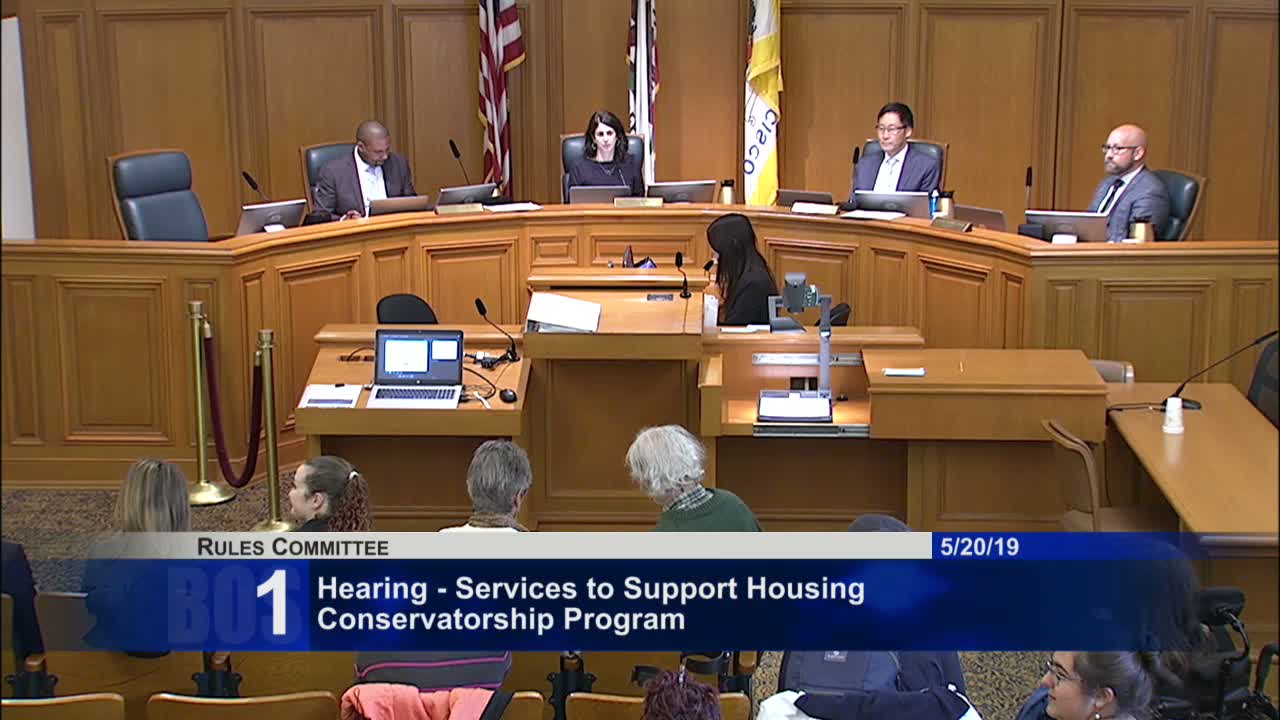
Rules Committee advances housing-conservatorship hearing after hours of testimony, but raises deep concerns
Summary
The Rules Committee continued its hearing on SB 1045 (housing conservatorship) and heard extended public comment and expert testimony. Committee members called the draft "unworkable" as written and voted to send the item to the full Board of Supervisors without recommendation.
San Francisco — The Rules Committee heard nearly three hours of testimony Monday on SB 1045, a proposed housing conservatorship aimed at people with serious mental illness and substance use disorders who have repeated involuntary psychiatric holds. After a presentation by the Department of Public Health (DPH) and a lengthy public-comment period dominated by opponents and supporters, the committee voted to move the matter to the full Board of Supervisors without a committee recommendation.
Dr. Angelica Almeida of DPH told the committee the conservatorship proposal is intended for a narrowly defined group: people ‘‘unable to care for their health and well-being’’ with a diagnosis of serious mental illness plus a substance use disorder and a history of repeated involuntary holds (the local presentation cited a threshold of multiple 5150 holds over the prior 12 months). DPH said it identified 55 people who met that strict profile in the local system, and described a flow in which outreach teams and assisted outpatient treatment (AOT) staff would attempt repeated engagement before a petition to the court was filed. The department emphasized outreach, a face-to-face assessment, court notice and support for attendance, and intensive wraparound services including possible transitions to permanent supportive housing.
But the public defender and many community speakers raised doubts about how the plan would work in practice. Deputy Public Defender Cara Chen, who manages the office’s mental-health unit, explained the public defender’s statutory role when clients are placed on involuntary holds and said counsel cannot ‘‘drag’’ a person to court if the person refuses to engage. Chen described repeated outreach and leaving contact information for absent clients, but said the SB 1045 procedure—unlike AOT—would not permit an absentia decision by the court, which could leave petitions indefinitely on hold if the person does not appear. She also described the resource burden for litigating multiple prior 5150 incidents, noting witnesses for each hold may need to be subpoenaed to sustain a petition.
Public comment ran long and sharply divided the room. Speakers in favor said the conservatorship could save lives for a small, acutely ill group who repeatedly cycle through emergency care and decline services; a number of clinicians and family members recounted individuals who they said had not responded to voluntary treatment. Opponents—ranging from disability-rights and public-health advocates to people with lived experience—described the bill as coercive, warned it risks escalating police involvement and disproportionate impacts on people of color, and argued the city has not demonstrated available services or housing to support the proposal. Medical witnesses cited limited evidence that forced treatment yields sustained benefits for addiction.
Supervisors echoed many of those themes during committee deliberations. Members praised the DPH presentation but questioned whether voluntary services had been tried thoroughly and whether the city had sufficient housing and treatment capacity to implement the program without displacing current clients. Several supervisors called the SB 1045 language internally inconsistent and ‘‘unworkable as currently drafted,’’ while noting their sympathy for people dying on the streets and the need for better systems of care. The committee chair moved the item to the full Board of Supervisors without recommendation so the full body can weigh in.
Next steps: Item 1 was referred to the full Board of Supervisors for consideration. No final policy or ordinance was adopted at Rules Committee; the measure will return to the Board for debate and any formal votes.