Get Full Government Meeting Transcripts, Videos, & Alerts Forever!
Get email alerts on the Surveillance Ordinance topic
No spam. Unsubscribe anytime.
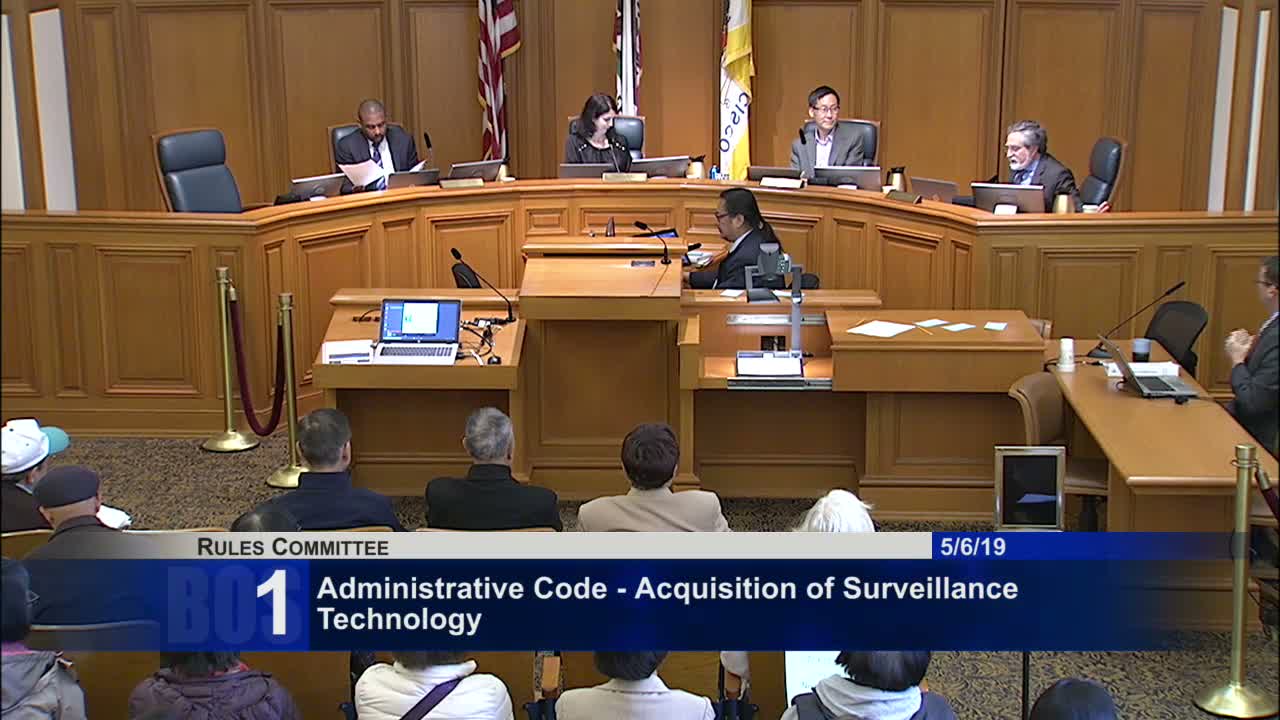
Rules Committee forwards surveillance-technology ordinance to full board, bars city use of facial recognition software
Summary
The San Francisco Board of Supervisors Rules Committee voted to forward an ordinance requiring departments to submit surveillance-technology policies and Surveillance Impact Reports; the committee adopted several amendments clarifying department use and reporting and included an explicit ban on city deployment of facial-recognition software.
The San Francisco Board of Supervisors Rules Committee on May 6 advanced an ordinance that would require city departments to submit Board-approved surveillance-technology policies and a Surveillance Impact Report before acquiring surveillance systems or accepting related grant funds.
Supervisor Aaron Peskin, who sponsored the ordinance, told the committee the measure is about public oversight and transparency rather than prohibiting surveillance outright. "This is really about public oversight of surveillance technology," Peskin said, adding that the ordinance would ban the city's use of facial-recognition software while preserving the ability of private individuals to provide video to police as tips.
Peskin described a package of amendments the committee added that modify reporting and implementation details. Among the changes, the ordinance removes a requirement to report specific manufacturer and model numbers from the main procurement filing, adds language clarifying that the city may "access or use" information received from non-city-owned surveillance systems, and explicitly preserves the city attorney's ability to receive and use surveillance-derived information in civil and administrative proceedings. Another amendment allows departments to submit consolidated surveillance-technology policies to reduce administrative burden; the Committee on Information Technology (COIT) will play a role in review.
The measure drew extended public comment from civil liberties groups, neighborhood organizations and merchants. Matt Cagle, an attorney with the ACLU of Northern California, urged the committee to adopt the ordinance to "bring surveillance technology out of the shadows," saying it protects immigrants and communities of color and preserves community input into whether the city should deploy drones, license-plate readers or algorithms. "This ordinance merges a streamlined process . . . with existing city expertise," Cagle said.
Opponents warned the ordinance could hinder routine police investigations and create red tape for merchants and residents who provide video evidence. Pius Lee of the Chinatown Neighborhood Association said merchants rely on cameras to work with police and worried new restrictions could impede those partnerships. Several speakers asked that the police commission and other law-enforcement stakeholders be consulted further.
Supervisor Peskin responded to the concerns by pointing to amendments that clarify departments can receive and use footage provided by residents and businesses, and by citing past misuse of technology: "We settled a lawsuit for $495,000" after a license-plate reader misidentified a vehicle, he said, arguing for safeguards. Supervisors Shamann Walton and Gordon Marr expressed support for oversight while acknowledging public-safety concerns. Chair Supervisor Hillary Ronan moved to accept the amendments, and the committee forwarded the ordinance to the full Board with a positive recommendation "as amended"; both actions passed without objection.
The ordinance as amended will now go to the full Board of Supervisors for further consideration. The committee did not enact the ordinance at the Rules Committee meeting; its positive recommendation sends the matter to the Board for possible final adoption or additional amendments.