Get Full Government Meeting Transcripts, Videos, & Alerts Forever!
Get email alerts on the Municipal Budget topic
No spam. Unsubscribe anytime.
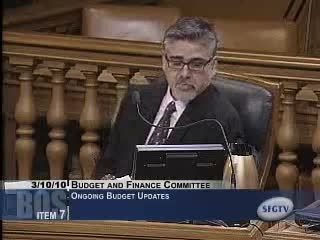
Mayor's budget office projects $522.2M deficit and proposes citywide 37.5-hour reorganization; workers and unions protest at committee hearing
Summary
Mayor's budget director Greg Wagner presented a $522.2 million general-fund deficit and a set of balancing proposals including converting many positions to a 37.5-hour workweek to save roughly $52.2 million; public comment was dominated by city workers and union leaders who criticized the plan's pace, fairness and operational risks and asked for bargaining and alternative revenue measures.
Greg Wagner, the mayor's budget director, told the Budget & Finance Committee the city faces a projected $522.2 million general-fund shortfall driven by a $290.7 million revenue decline (chiefly property-tax losses) and $231.5 million in expenditure increases. To close the gap the administration outlined a multi-pronged plan: use part of the rainy-day reserve, seek state and federal revenue adjustments, reduce the capital program, pursue vendor/contract reductions and move to a citywide reorganization that increases the use of part-time 37.5-hour positions to produce roughly $52.2 million in general-fund savings.
Wagner said departments supplied candidate expenditure reductions that could total $115 million and that additional choices will be required. He and other officials said certain classifications were excluded (uniformed police and firefighters, some public-safety dispatch/911 functions, specific DPH patient-care classes and others) because operational needs, charter constraints or premium labor provisions made hour reductions infeasible. But he and the controller (Ben Rosenfield) noted managers, department heads and many other categories would be included: roughly 92.9% of management received notices and department heads were asked for voluntary 10% reductions.
The committee heard extensive public comment across dozens of speakers, many of them city employees and union representatives. Labor leaders argued the plan was hasty, ill-conceived and would cause harm to frontline services, while some residents and nonprofit leaders urged creative revenue options and structural reforms instead of broad cuts. Multiple employees described the stress of pink slips and uncertainty about recall to part-time positions, and union speakers urged negotiation and consensus-driven measures. Supervisors pressed for more granular analysis of where cuts would fall, how services would be preserved, and asked the administration to work with labor to develop alternatives. The committee agreed to continue budget updates and hearings and asked the administration and DHR to provide more detailed impacts, counts of positions not expected to be rehired and scenarios for public-safety departments.