Get Full Government Meeting Transcripts, Videos, & Alerts Forever!
Get email alerts on the Historic Preservation topic
No spam. Unsubscribe anytime.
Supervisors continue Mills Act request for 178 Townsend, seek clearer valuation and tax-impact figures
Summary
Supervisors continued consideration of a Mills Act historic-property contract for 166–178 Townsend Street after questions about tax delinquencies, the scope of tax reductions (facade vs. building volume) and pending assessor valuations; project sponsors say financing is contingent on Mills Act benefits.
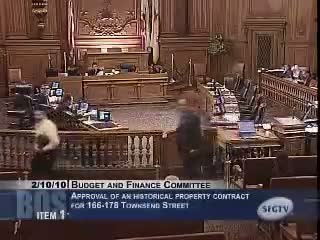
The Budget and Finance Committee on Tuesday continued a request from developer 178 Townsend Properties for a Mills Act historic-property contract covering 166–178 Townsend Street, asking for more precise assessments of what portion of the project would qualify for the tax benefit and what the city’s potential revenue loss would be.
Chair John Avelos said the resolution — returned to committee after prior continuances — raised concerns including developer delinquencies in property taxes and whether the Mills Act benefit should be limited to the remaining historic fabric rather than applied across newly constructed volume. Avelos said he wanted planning and assessor analysis before any approval.
Tara Sullivan of the Planning Department told the committee the board has discretion to define the contract’s scope and that planning staff recommended including the historic envelope and the interior volume within that envelope. Sullivan said her office had asked the project sponsor for a corrected calculation after the sponsor characterized the volume as about 65% of the total development.
Mr. Rose, the budget analyst presenting the staff review, urged the supervisors to continue the item until the assessor produces a specific estimate of annual property-tax loss from the revised contract. His report also noted that the Board previously approved authorization for up to $33 million in tax-exempt revenue bonds through ABAG for the project’s financing and that attachments to the report included a developer analysis claiming about $690,000 in city benefits that staff had not been able to independently verify.
Project sponsor Patrick McNearney said the financing was not final and told the committee that financing was “absolutely contingent on the Mills Act,” adding that without the tax-benefit the project would face a shortfall. McNearney also described proposed community benefits — including volunteered childcare facilities in lieu of paying an Eastern Neighborhoods impact fee — and said planning supported those mitigations.
Public testimony included preservation advocates who urged inclusion of the building’s volume under Mills Act protection and architects for the sponsor who described why they measure historic contribution as cubic volume rather than a straight square-foot comparison.
Given outstanding valuation work from the assessor and the project sponsor’s revised submission, the committee voted to continue the item to the call of the chair pending a clarified historical-property contract, assessor estimates of tax loss and the sponsor’s revised calculations.
The committee asked staff to prepare two assessor valuations: one limited to the facade/historic walls and one that would value the historic envelope and internal volume as proposed by planning. The assessor said that analysis would likely take about three weeks.