Get Full Government Meeting Transcripts, Videos, & Alerts Forever!
Get email alerts on the Inclusionary Housing topic
No spam. Unsubscribe anytime.
Deep debate on inclusionary-housing changes: committee amends language and pauses for further review
Summary
Supervisors debated an ordinance to raise inclusionary housing requirements, set temporary 25% thresholds, and implement tiered grandfathering for pipeline projects; planning staff outlined grandfathering tiers and the committee approved a technical amendment and voted to continue the item for one week to allow further review.
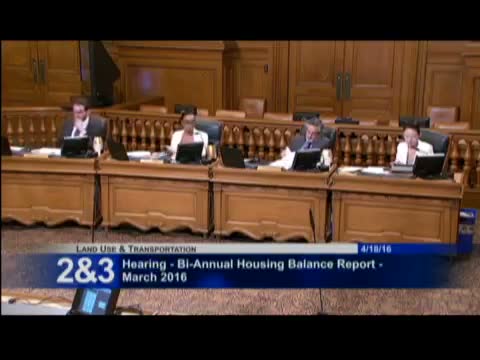
The Land Use and Transportation Committee on April 18 conducted a lengthy, contested hearing on trailing legislation to implement the inclusionary-housing changes tied to Proposition C. Sponsors Supervisors Jane Kim and Aaron Peskin described the ordinance as "grandmothering" or "grandfathering" trailing legislation that would apply higher inclusionary percentages to future projects while giving graduated increases to projects already in the pipeline based on filing date.
Kim said the ordinance seeks to capture more affordable units from market-rate development, while Peskin described a negotiated compromise with the mayor's office, developers and building trades. Opponents, including Supervisor Scott Weiner and others, warned that imposing a uniform 25 percent requirement (for projects of 25 units or more) before a full economic feasibility study risks rendering many projects infeasible, reducing overall housing production and possibly costing union jobs.
Planning staff presented technical details: three grandfathering tiers based on environmental evaluation application (EEA) dates (pre-2013, 2014, 2015) with estimated potential units in each tier (tier A ~2,241; tier B ~1,878; tier C ~8,123). Staff also described zoning-based nuances (UMU tiered rates and caps) and recommended capping grandfathered percentages at 33 percent so temporary rates would not exceed permanent rates in any case.
Public comment ran long and polarized the room. Labor representatives warned that heavier burdens on large projects could push developers to nonunion contractors and intensify wage theft on smaller projects; developers said they needed predictability and argued that some existing pipeline projects would be made infeasible. Housing advocates urged moving forward to expand affordable housing production.
On the ordinance text, the committee adopted a motion (mover: Supervisor Peskin) to delete a Mission NCT exception in the grandfathering language so the Mission NCT would be treated like other areas; that amendment passed. Multiple other late amendments and clarifying language were read into the record, and, amid objections about the pace and last-minute changes, the committee voted to continue the item for one week to allow staff and supervisors to reconcile technical fixes and circulate final text.
The committee's actions postpone final committee recommendation while preserving several negotiated elements (tiered bumps tied to filing date, planning department oversight and a feasibility study to be completed per the charter amendment process).