Get Full Government Meeting Transcripts, Videos, & Alerts Forever!
Get email alerts on the Homelessness topic
No spam. Unsubscribe anytime.
Shelter Monitoring Committee reports fewer infractions, fewer complaints in 2017–18; navigation centers to be added
Summary
The Shelter Monitoring Committee told the Rules Committee it completed mandated site visits in 2017–18, recorded 114 infractions (a drop from the prior year), received 174 complaints from 98 unduplicated clients (a 20% decrease), and recommended system tweaks; staff said navigation centers will be brought under monitoring once standards application and committee capacity are resolved.
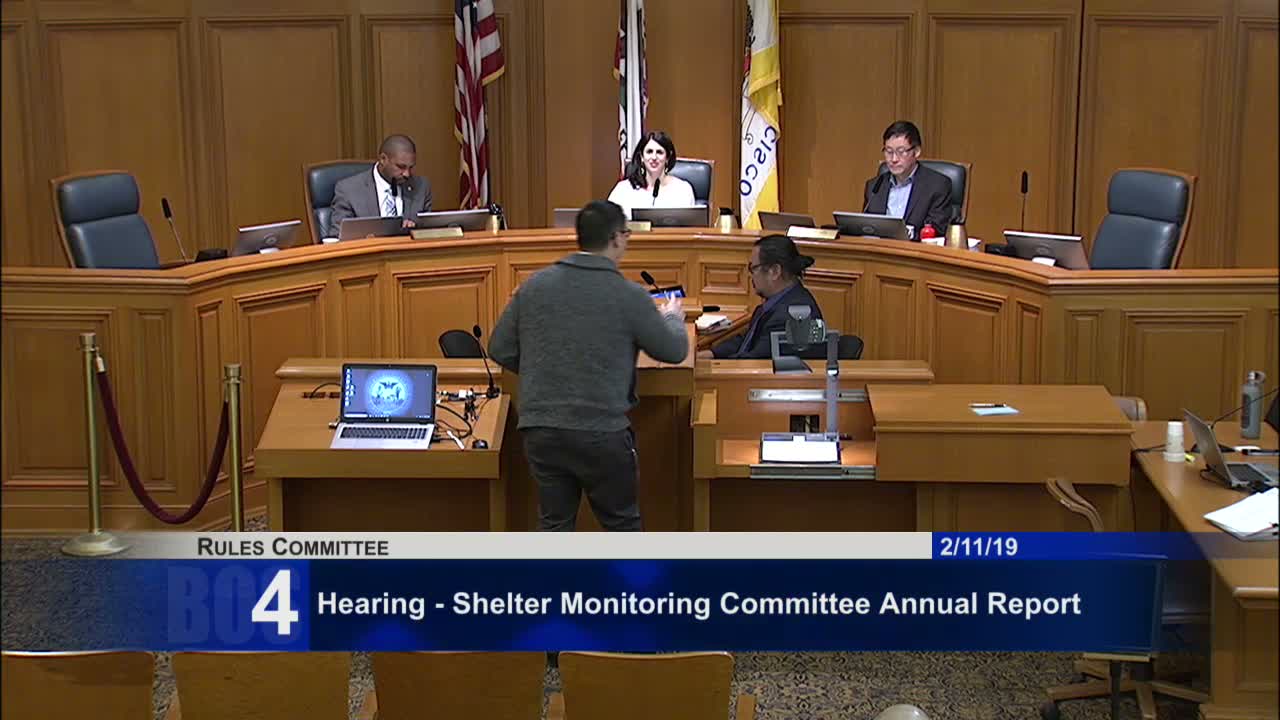
Howard Chen, policy analyst for the Shelter Monitoring Committee, and committee member Jonathan Adler presented the 2017–18 annual report to the Rules Committee on Feb. 4.
Chen described the committee's structure (13 volunteers; about half should be homeless or formerly homeless) and duties (six site visits per monitored site with four unannounced visits and two announced visits each year, complaint intake and referral, and monitoring compliance with the 32 Standards of Care). For fiscal year 2017–18, the committee completed 117 site visits (100% of mandate), recorded 114 standards-of-care infractions (a reduction of 40 from the prior year), and received 174 complaints filed by 98 unduplicated clients — decreases the presenters characterized as improved compliance.
Jonathan Adler summarized findings: the most commonly cited infractions involved cleanliness and hygiene supplies (Standard 3), ADA compliance and posting of shelter rules (Standard 8), provision of sheets and blankets (Standard 12), communication in clients' primary languages (Standard 21), and staff ID badges (Standard 25). Chen and Adler noted site-to-site variation (some shelters had few or zero infractions; others had higher counts) and that the same standards tended to account for most infractions year-to-year.
Supervisors asked why navigation centers had not been monitored; Shelter Monitoring staff and Scott Walton of the Department of Homelessness and Supportive Housing explained navigation centers were newer and required a review of which standards apply. Staffing constraints at the committee, overlapping term expirations, and the workload from adding approximately 30 more site visits were cited as practical limits; Walton said the department expects the committee to begin monitoring navigation centers later in 2019 after clarifying standards and onboarding new members.
The committee also described complaint handling: complaints are received by phone, email or drop-in hours; serious allegations (violence, fraud, extreme misconduct) are forwarded to contract monitors and the Department of Homelessness. Committee staff acknowledged temporary understaffing earlier in the year reduced drop-in availability and that they reduced drop-in days from four to two while accommodating appointments as needed.
Supervisor Gordon Marr moved to file the hearing; the chair announced the hearing had been "heard and filed" without objection.