Get Full Government Meeting Transcripts, Videos, & Alerts Forever!
Get email alerts on the Illegal Units Legalization topic
No spam. Unsubscribe anytime.
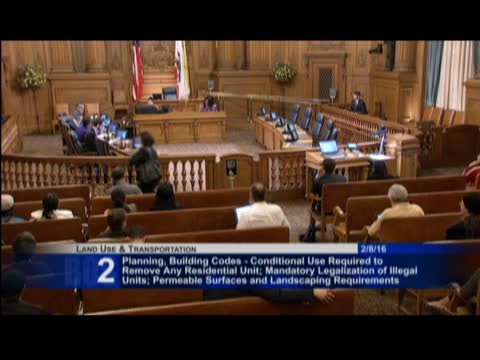
Committee advances C3 protections against illegal commercial‑to‑residential conversions; in‑law/legalization work continued
Summary
The committee duplicated Supervisor Avalos's ordinance and moved the C3 (commercial districts) portion forward as a committee report to preserve housing where commercial space was converted to residential without permits; the in‑law/single‑family legalization portion was continued for DBI review and additional amendments.
Supervisor Avalos introduced an ordinance to require conditional use authorization for removal of any residential unit and to amend the building code to require notices of violation and mandate legalization of illegal units unless infeasible. Supervisor Kim and tenant advocates described long-standing conversions in C3 districts in which properties that had been used as residential units for years were later reverted to commercial use and residents displaced when commercial rents rose.
Planning and building officials described the technical approach. Aaron Starr (Planning) said the ordinance would require legalization of an unauthorized unit unless the Planning Commission grants conditional use authorization to remove it, giving planners a mechanism to require legalization and life‑safety corrections rather than permit an unreviewed removal. Bill Strong (DBI) reported the database review (2010–2015) found about 446 notices of violation and 49 permits for removal/legalization in that period; since passage of a voluntary legalization program DBI has issued 105 legalization permits and planning has another ~110 under review, projecting roughly 200–220 legalized units by the program’s two‑year anniversary.
Public testimony was extensive and divided. Tenant advocates, artists and housing rights groups urged the ordinance to protect long‑term tenants and asked for retroactivity to preserve dozens of at‑risk units. Small property‑owner groups, the apartment association and some architects urged more study, raised CEQA and state building‑code concerns, and warned mandatory legalization could produce unintended effects for low‑income owners. Brian Chu (Mayor’s Office of Housing and Community Development) said available housing‑trust funds and existing single‑family rehab programs (income‑limited to owners below 120% AMI) could help some homeowners pay for legalization work.
To allow prompt action where conversion risk is concentrated while giving more time to negotiate complex policy and technical details, the committee agreed to duplicate the file. The committee moved the C3 portion forward as a committee report to the full Board and continued the duplicated file containing in‑law and single‑family issues to Feb. 22 for additional DBI and stakeholder review. Supervisor Wiener successfully moved an amendment to remove single‑family homes from the conditional use requirement in the continued file, citing existing demolition controls for houses.
Next steps: The C3 portion will proceed as a committee report to the full Board; the in‑law/single‑family portion will return to committee after DBI review and additional amendments scheduled for Feb. 22.