Get Full Government Meeting Transcripts, Videos, & Alerts Forever!
Get email alerts on the Transportation Sustainability Fee topic
No spam. Unsubscribe anytime.
Land Use Committee forwards modest TSF increase for very large commercial projects with negative recommendation
Summary
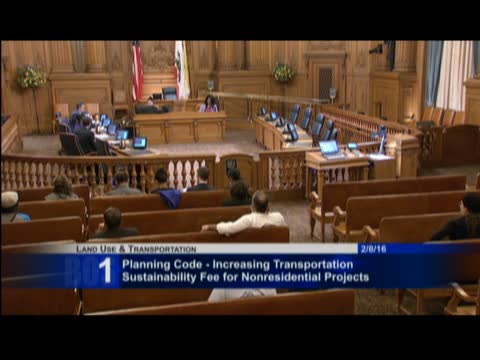
The committee debated amendments to the Transportation Sustainability Fee (TSF) that would raise fees for very large nonresidential projects and require a partial catch-up payment for certain older filings; the panel voted to send the item to the full Board with a negative recommendation (2–1).
Supervisor Avalos, sponsor of Item 1, urged the committee to approve two targeted changes to the Transportation Sustainability Fee intended to better align commercial charges with residential impacts and to capture revenue from grandfathered projects. Avalos said the amendments would raise the fee for nonresidential square footage above 100,000 square feet by roughly two dollars per square foot for very large projects and require projects filed before July 21, 2015 that had not yet received final approval to pay 50% of the difference between the Transit Impact Development Fee (TIDF) and the TSF. "These are the items we have before us and I urge your support," Avalos said, arguing the changes would generate about $2,000,000 per year and roughly $30,000,000 in one‑time funds for transportation.
Advocates and agency staff told the committee the analysis supports a modest increase for large commercial prototypes. Planning staff and the nexus/economic feasibility studies were cited repeatedly as showing the commercial sector generates substantially greater transportation impacts than individual residential units and that commercial prototypes over 100,000 square feet remain financially feasible at the higher fee level.
Supervisor Wiener opposed moving the amendment forward at committee. Wiener said the board only recently adopted a new TSF for residential and commercial development and that adding more immediate increases "is not the way to do legislation." He added, "I will not be supporting this ordinance today," and urged the committee to let the recently adopted TSF take effect. Supervisor Peskin acknowledged fees needed periodic updating and said the extra charge for >100,000 sq ft appeared sustainable, but he pressed for restoring some flexibility to allow the MTA to use a portion of funds for operations — not only capital — arguing the distinction between capital and operating can be gray for maintenance and midlife overhauls.
Public commenters were split. Transit advocates and livability groups backed the fee change and urged allowing flexibility for operations in limited circumstances. The San Francisco Chamber of Commerce opposed the surprise increase, saying stakeholders had worked in December to set fee levels and that the new increase arrived without adequate notice.
After debate about the legal scope of expenditure‑side changes, the committee voted on a motion to forward the ordinance to the full Board with a negative recommendation. Roll call recorded Supervisors Wiener and Cohen voting "aye" and Supervisor Peskin "no." The motion passed and the item will proceed to the full Board with a negative committee recommendation.
Next steps: The full Board will consider the ordinance on the February 23 agenda; the committee record reflects remaining disagreements about possible operating flexibility and the ordinance's final form will be resolved at the Board stage.