Get Full Government Meeting Transcripts, Videos, & Alerts Forever!
Get email alerts on the Housing Unit Removal topic
No spam. Unsubscribe anytime.
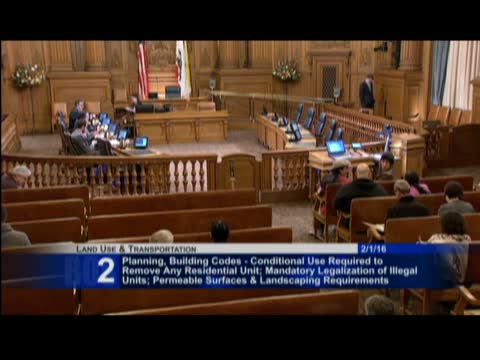
San Francisco committee advances ordinance to require review before removal of housing units; continues debate over costs and retroactivity
Summary
The Land Use & Transportation Committee debated an ordinance that would require Planning Commission conditional‑use review before removal of any housing unit (including unauthorized 'in‑law' units); supervisors accepted amendments (including a proposed March 1, 2016 retroactivity date) and continued the item one week to resolve funding and single‑family home questions.
Supervisor David Avalos introduced an ordinance to require conditional use (CU) authorization before any residential unit—legal or unauthorized—can be removed, and to mandate notice and potential legalization when a notice of violation (NOV) identifies an unauthorized unit. Avalos said the measure shifts the burden of proof to property owners seeking removal and aims to halt the loss of existing affordable units amid ongoing evictions and conversions.
Planning Department staff (Kimiya Haradon) told the committee the department and Planning Commission support the change because it creates consistent rules across zoning districts, removes two administrative removal routes (a pricing threshold and an 'unsound building' technical report) and creates a new, code‑based definition of "unauthorized unit." Planning also proposed three findings the commission must weigh when deciding removal: (1) whether the unit is eligible for legalization, (2) whether legalization costs are reasonable (based on the department's legalization cost database), and (3) whether legalization is financially feasible (measured by certified appraisal of value added). Haradon said exemptions remain for units that present imminent safety hazards or where no legal path to legalization exists.
Department of Building Inspection Commissioner Deborah Walker described DBI efforts to expedite voluntary legalization and to notify tenants when enforcement actions occur. Walker said legalization has not been broadly successful to date and advocated coupling stronger review with financial assistance—either loan or grant programs—to help owners bring units into compliance without displacing tenants.
City economist Ted Egan presented an economic impact assessment that concluded curtailing removals (historically about 23 per year) could increase supply at the low end of the market and reduce low‑end housing prices by roughly 1 percent, while having substantially smaller price effects at the top of the market. Egan described the ordinance as a trade‑off between preserving lower‑end housing and slightly constraining expansion of higher‑end units.
Supervisors pressed planning and DBI on costs and program capacity: planning staff reported legalization costs ranging from about $1 to $150,000 with an average near $55,000; the existing code‑enforcement revolving loan fund was stated as about $4,000,000 with a possible additional $1,000,000 discussed. Committee members and commenters warned that, if mandatory legalization is required without adequate funding or staged assistance, some owners may be unable to comply and units could become vacant. Planning emphasized that where no legal path to legalization exists, removal without CU would be allowed.
Members of the public (including multiple tenants from 1049 Market Street and representatives of tenant‑advocacy groups) urged the ordinance be made retroactive to March 1, 2016, and urged swift action to prevent evictions they described as already underway. Tenant speakers described long, consequential eviction fights and said conditional‑use review would have provided oversight that was absent in earlier over‑the‑counter removals.
Property‑owner representatives and small landlords raised legal and procedural objections, including claims the ordinance could amount to a rezoning requiring CEQA review, potential conflicts with state law (Ellis Act and building code), and the risk of increasing vacancy or unsafe residential reuse of commercial space if owners are compelled to retain units they cannot legally or economically maintain.
Supervisor Avalos read amendments into the record (clarifying grandfathering language so over‑the‑counter permits are not exempt, retroactivity to 03/01/2016 for certain permits, and changes affecting C3 ground‑floor language). The committee accepted the amendments and moved to continue the ordinance one week to allow staff and supervisors to refine funding options and consider whether single‑family homes (outside the in‑law legalization context) should be handled on a separate track. The continued hearing will also allow the City Attorney and departments to respond to specific legal/administrative questions raised during public comment.
The committee did not adopt the ordinance at this hearing; it accepted amendments and continued the item for further consideration.