Get Full Government Meeting Transcripts, Videos, & Alerts Forever!
Get email alerts on the Planning Affordable Housing topic
No spam. Unsubscribe anytime.
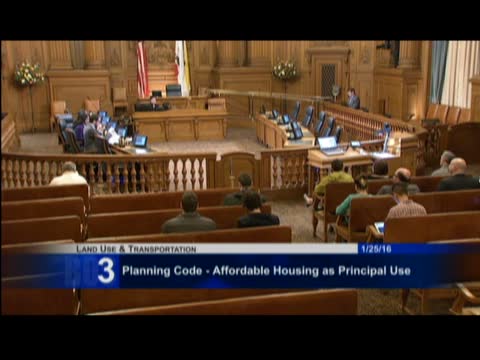
Board committee backs code change to speed 100% affordable housing approvals
Summary
The Land Use & Transportation Committee voted to forward Supervisor Scott Wiener’s ordinance allowing 100% affordable housing projects to be treated as a principal use, eliminating a conditional‑use hearing in uncontested cases to shorten approval timelines; planning review and neighborhood notification will remain in place.
Supervisor Scott Wiener’s ordinance to streamline approvals for 100% affordable housing projects was forwarded with a positive recommendation by the Land Use & Transportation Committee on Jan. 19.
Wiener told the committee the change would reduce uncertainty and cut months off approval timelines for projects that face no opposition, saying the measure "will make it easier and faster and less expensive to build affordable housing in San Francisco." He emphasized the proposal applies only to projects that are 100% affordable and that design review and neighborhood notification will continue.
Monica Mohan of the Planning Department told the committee the Planning Commission had considered the proposal on Dec. 3 and was unable to reach a recommendation; staff introduced substitute language to clarify exceptions for grocery stores, movie theaters and projects that trigger a conditional use for parking. The ordinance defines affordable housing for these purposes as units restricted as affordable for at least 55 years.
Speakers from nonprofit developers and housing advocates supported the change at the committee hearing, saying conditional‑use hearings can add three to 12 months — and sometimes more — to project schedules, making it harder to meet financing deadlines. Rob Poole of the San Francisco Housing Action Coalition said developers "need to do everything we can to get affordable units online faster." Several nonprofit developers including Bridge Housing, Mercy Housing and John Stewart Company also testified in favor.
Opponents urged caution. Eileen Bokin and other commenters said the city should instead improve Planning Department efficiencies or add staff, and warned that removing conditional use could shift decisions "internally" and reduce transparent public engagement. Bokin said the change "seeks to improve the processing time for 100% affordable housing projects by cutting corners." Supervisor Aaron Peskin raised similar concerns during the supervisor debate and said conditional use has helped ‘‘hone’’ projects in the past.
Wiener and supporters said the ordinance preserves public participation: projects will remain subject to intensive design review, neighborhood notifications and a path to discretionary review and Planning Commission hearings if a project attracts opposition. After supervisors debated amendments and circulated substitute language to align the file with the introduced version, the committee voted to amend and forward the ordinance to the full Board of Supervisors with a positive recommendation.
The committee’s action sends the ordinance to the full board; no final Board vote had occurred at the close of the meeting.