Get Full Government Meeting Transcripts, Videos, & Alerts Forever!
Get email alerts on the Cannabis Regulation topic
No spam. Unsubscribe anytime.
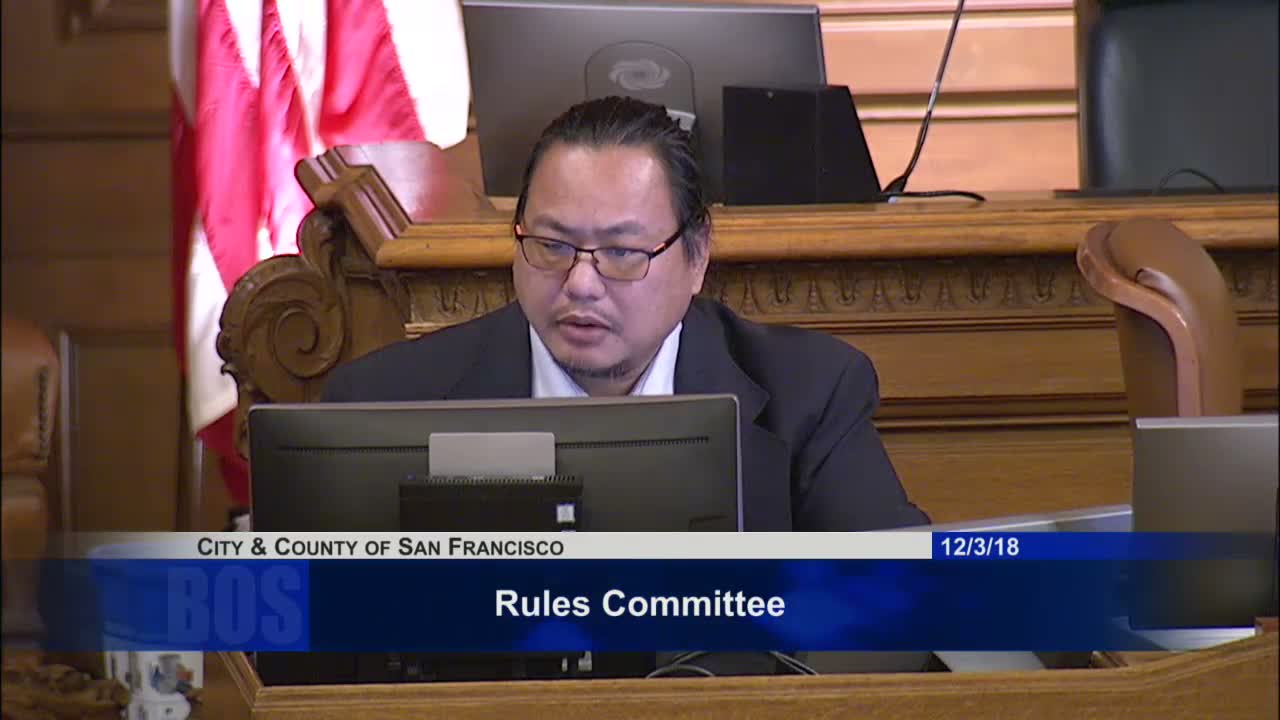
Rules Committee splits cannabis ordinance debate over equity caps and fast delivery
Summary
The Rules Committee debated changes to San Francisco—s cannabis ordinance on Dec. 3, 2018, including whether to limit equity applicants— ability to hold multiple priority permits, whether AMI eligibility should be adjusted, and whether to restore dynamic (fast) delivery; the committee duplicated the file and referred dynamic delivery for environmental review.
The San Francisco Board of Supervisors Rules Committee on Dec. 3 debated revisions to the city—s commercial cannabis code focused on two flashpoints: how to structure the equity program so it benefits people harmed by the war on drugs, and whether to permit fast or "dynamic" delivery.
Chair Supervisor Asha Safae framed the committee—s approach as an effort to "create as many opportunities for as many people as possible," while warning a small number of applicants could otherwise occupy multiple priority permits and reduce openings for others. President Malia Cohen, who led early development of the equity program, said the rules were meant to help people and communities disproportionately affected by enforcement and incarceration.
The committee discussed three interlocking changes: whether the income-based AMI (area median income) threshold for equity applicants should remain at 80% as a qualifying option or be raised as an absolute cap (some supervisors urged raising an absolute cap from 120% to 150% AMI), whether equity applicants should be limited in the number of priority permits they may hold in the first batch, and whether the ordinance should restore dynamic delivery.
Lee Hebner, speaking for Supervisor Aaron Peskin—s office, described an amendment that would count any ownership interest toward a retail cap and increase that cap from two storefront permits per owner to four, so that a fifth pending application would be placed on hold pending further review. Deputy Director Eugene Hillsman of the Office of Cannabis said staff have seen only a "relatively low" share of applicants modifying filings after submission — "maybe 1 or 2%" — and Director Nicole Elliott said roughly 24% of applications lacked income verification in the files they had received to date.
Public comment ran for more than two hours. Equity-verified applicants and community groups warned that retroactive limits on multiple priority permits would undermine the investments they had already made and expose them to legal and financial liability; several speakers urged that any changes be prospective rather than retroactive. Others — including delivery companies, labor advocates and patient groups — urged the committee to restore dynamic delivery to preserve jobs and timely access for patients. Opponents, including San Franciscans Against Traffic Congestion, asked the committee to subject dynamic delivery to CEQA, saying the change could increase circulating delivery vehicles and congestion.
After deliberation the committee agreed without objection to duplicate the ordinance file: one version will remain in committee preserving President Cohen—s equity language, while a duplicated file will retain the dynamic-delivery language and be continued to the call of the chair with an added CEQA-finding section to trigger an environmental review. The committee also agreed to return the equity AMI language in the version sent to the full board to the original structure where 80% AMI is one of the optional criteria rather than an absolute threshold.