Get Full Government Meeting Transcripts, Videos, & Alerts Forever!
Get email alerts on the Transportation Policy topic
No spam. Unsubscribe anytime.
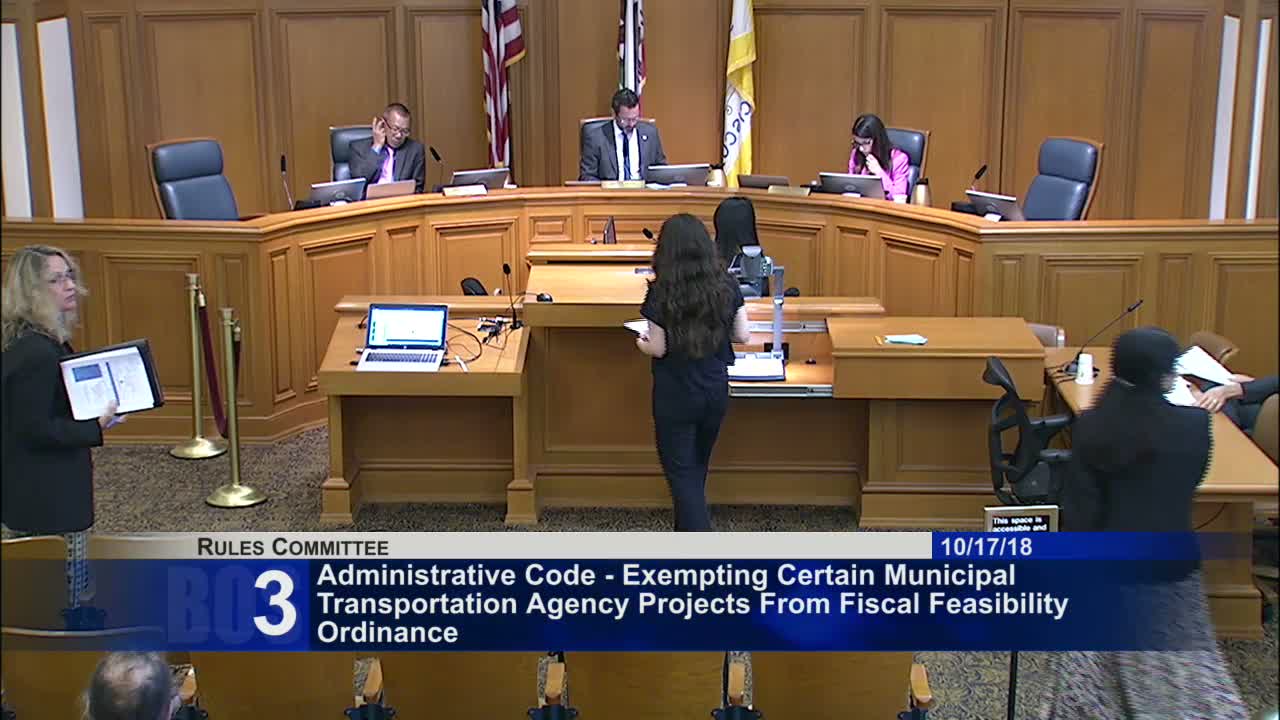
Committee approves carve-out for large SFMTA projects from fiscal‑feasibility review
Summary
The Rules Committee voted to send an ordinance to the Board exempting large San Francisco Municipal Transportation Agency projects that expand municipal railway service from the fiscal‑feasibility ordinance, to reduce barriers to applying for competitive state and federal funding.
The Rules Committee recommended that the Board of Supervisors consider an amendment to Chapter 29 of the Administrative Code to add a carve‑out exempting capital improvement projects under the jurisdiction of the San Francisco Municipal Transportation Agency (SFMTA) that support municipal railway service from the city’s fiscal‑feasibility requirement.
Sunny Angulo, chief of staff for Supervisor Aaron Peskin, said the change is procedural: it does not alter the dollar triggers in the existing ordinance (projects of $25 million or more with at least $1 million in city funding) but adds large SFMTA muni‑service expansion projects to the list of exclusions so agencies can pursue competitive state and federal grants without the additional step of a fiscal‑feasibility finding (SEG 688–707; SEG 752–766). Deputy City Attorney John Gibner and SFMTA staff clarified that both the construction threshold and the city‑funding threshold still apply for projects not covered by the carve‑out (SEG 739–766).
No public commenters spoke in opposition. Supervisor Yee moved to send the item to the full Board with a positive recommendation and the committee approved the motion without objection.
The committee record shows the procedural change only; agencies pursuing an exemption should still confirm eligibility and applicable thresholds in the final ordinance text.