Get Full Government Meeting Transcripts, Videos, & Alerts Forever!
Get email alerts on the Arra Funding topic
No spam. Unsubscribe anytime.
City's ARRA update: nearly $600M in federal recovery funds, focus on jobs and accountability
Summary
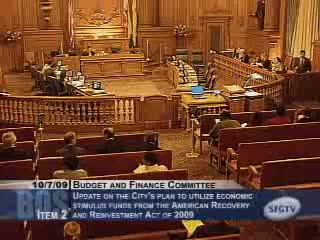
Mayor's office told the Budget & Finance Committee San Francisco stands to receive roughly $500—60M in ARRA funds across transportation, health and human services, housing, and public safety; officials emphasized reporting, a local recovery website, and the one-time nature of the funding.
Kate Howard of the Mayor's Office briefed the Budget & Finance Committee on the city's awards and plans for American Recovery and Reinvestment Act (ARRA) dollars, telling supervisors that San Francisco will benefit from federal recovery funding across transportation, health/human services, housing, workforce development and other categories.
Howard presented a tally she characterized in two ways during the briefing: she first referenced "more almost $500,000,000" and later cited a figure of $597,000,000 in federal recovery funds coming into the city, including amounts that flow to city agencies and other entities that benefit San Francisco (for example, Caltrans funding for Doyle Drive). She said transportation and health/human services are major categories, with nearly $30 million to San Francisco International Airport for runway safety/security and roughly $67 million to MTA for capital improvements (bus rehab and fare equipment).
On workforce development, Howard highlighted the JobsNow program (a Mayor's Office initiative to subsidize placements) with a goal of 1,000 placements over 12 months; eligibility requires San Francisco residency, authorization to work and having a minor child in the household, and income under 200% of the federal poverty level (the program is funded in part through TANF-related sources). On housing, she reported the Housing Authority was awarded about $15.3 million for energy-efficiency rehab, increasing its award substantially; the school district was slated to get about $23 million.
Howard also outlined public-safety grants: an increase in the JAG allocation to roughly $3 million for prosecutors, probation officers and violence prevention work, and a competitive COPS grant that would fund up to 50 police officer positions subject to federal use restrictions. She identified $7.7 million in Energy Efficiency and Conservation Block Grants for municipal and residential retrofits, and large "other" awards including $50 million for Doyle Drive and an approximately $121 million federal allocation to retrofit 50 UN Plaza (a federally owned building, where the money is for the building rather than the plaza).
Howard emphasized transparency and reporting: the city has a recovery website (recoverysf.org) that will list grants applied for, pending and awarded and will include maps to show citywide distribution of funds. She noted reporting obligations to the Office of Management and Budget and grant agencies include how much money is awarded, how much is spent and how many jobs the funds create. Multiple layers of monitoring were described (GAO, OMB, funding agencies, local controller and city attorney), and Howard said departments, the controller's office and OCA will play oversight roles locally.
Supervisors questioned the durability of ARRA-level funding and whether any elements could be reauthorized; Howard said some components (for example, energy-efficiency block grants) were the subject of lobbying but that a reauthorization of ARRA at the same scale was unlikely. Committee members underscored the importance of showing results on the ground so constituents can see the impact of investments.
The committee asked for follow-up reporting once the city submitted initial federal reports so supervisors can review actual expenditures and job metrics.