Get Full Government Meeting Transcripts, Videos, & Alerts Forever!
Get email alerts on the Transportation Sustainability Fee topic
No spam. Unsubscribe anytime.
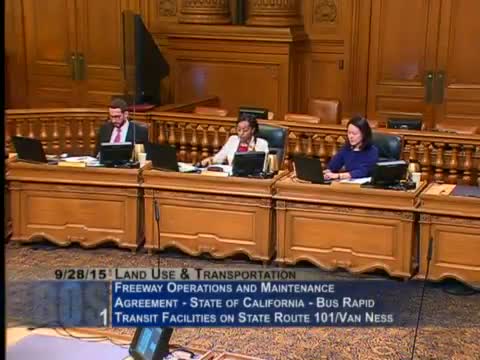
Land Use Committee continues debate on citywide Transportation Sustainability Fee after extensive public comment
Summary
The committee heard a multi-hour presentation and broad public comment on a proposed Transportation Sustainability Fee (TSF) that would expand transit impact fees to market-rate residential and large institutions; staff presented proposed rates ($7.74/residential; $18.00/nonresidential; $7.61/PDR), a feasibility approach, exemptions and grandfathering rules; the committee continued the item to October 5 for further amendments.
The Land Use and Transportation Committee on Wednesday held an extended hearing on a proposed Transportation Sustainability Fee (TSF) ordinance that would replace the existing Transit Impact Development Fee, expand fee coverage to market-rate residential projects and large institutions, and change how the city credits or exempts certain plan-area and nonprofit projects.
Supervisor Scott Wiener framed the item as “an important revamp” of how San Francisco pays for transportation improvements tied to growth. Planning and transportation staff described the TSF as the fee element of a three-part Transportation Sustainability Program that also includes travel-demand management strategies and pending CEQA reforms.
Alicia Jean Baptiste of the San Francisco Municipal Transportation Agency summarized the ordinance and supporting analyses. She told the committee the proposal would establish a new residential fee of $7.74 per gross square foot, a nonresidential fee stated in the presentation as $18.00 per gross square foot, and a production-distribution-repair (PDR) rate of $7.61. Staff said consultants prepared a Nexus study (to quantify impacts) and a feasibility analysis; the feasibility work tested the proposed rates against ten prototype project types and used a 10% reduction in residual land value as a commonly used threshold for when a fee level could push a project into “infeasible” territory. Staff said the chosen marker of 125% of a 2012 baseline rate represented a balance point intended to maximize revenue without rendering many prototypes infeasible. The presentation included a Market Octavia example showing how the TSF and plan-area fee credits would combine for a hypothetical project.
Staff projected the TSF would produce roughly $14 million in net new revenue and about $38 million per year in total funding for transportation when combined with existing TIDF receipts. The ordinance as presented would exempt affordable and middle-income housing, small residential projects, qualifying small businesses and most nonprofits; it would apply to market-rate residential projects of 21 units or more and to private universities or institutions that exceed institutional master-plan size thresholds. Staff also explained a proposed hospital exemption tied to the statewide seismic retrofit schedule: hospitals would be exempt while they complete required seismic upgrades, with the ordinance suggesting reconsideration at a future date tied to completion of that work.
The hearing drew more than two dozen public commenters representing universities, hospitals, transit and pedestrian advocates, neighborhood groups, developers and housing advocates. University of San Francisco representatives urged that USF be exempted because the campus is not growing enrollment and proposed student housing would house existing students. Hospital representatives described steep seismic retrofit costs and said applying the TSF to nonprofit hospitals could jeopardize community-benefit programs; they urged exemptions or tailored treatment. Transit and pedestrian advocates largely supported the TSF and pressed for higher revenue targets (the planning commission recommended exploring up to 33% of the nexus), inclusion of parking in the fee base, and a clearer commitment that funds be directed to capital investments for transit, walking and biking. Developers and housing-builders warned that higher fees could push marginal projects past feasibility thresholds and urged staged grandfathering for projects already in the pipeline.
Supervisors debated a set of possible amendments: Supervisor Jane Kim proposed tiering fees by project size (units or square footage), reconsidering area-plan credits, and exploring exemptions for nonprofit higher-education institutions; Supervisor John Avalos favored using charity-care levels rather than nonprofit status to determine hospital exemptions; Supervisor Weiner said he remained committed to the negotiated hospital exemption tied to the seismic retrofit schedule but was open to other changes so long as feasibility analyses supported them.
After discussion, Chair Malia Cohen moved — and Supervisor Jane Kim seconded — to continue the item for one week to the October 5 Land Use Committee meeting to allow time for drafting amendments and further consultation. The committee approved the continuation unanimously. No final ordinance vote was taken at this hearing.
Next step: staff and supervisors will use the additional week to refine fee tiers, grandfathering language and exemption criteria before the committee resumes deliberations.