Get Full Government Meeting Transcripts, Videos, & Alerts Forever!
Get email alerts on the Central Soma Plan topic
No spam. Unsubscribe anytime.
Rules committee refers Central SoMa plan changes and special tax financing to Land Use
Summary
The Rules Committee referred ordinances implementing the Central SoMa area planincluding admin-code protections for PDR and a technical amendment to the citys special tax financing lawto the Land Use Committee on July 16, leaving substantive debate for that body. Planning staff said the plan would add 16 million square feet of capacity and deliver about $2.2 billion in public benefits, with 33% of housing units permanently affordable.
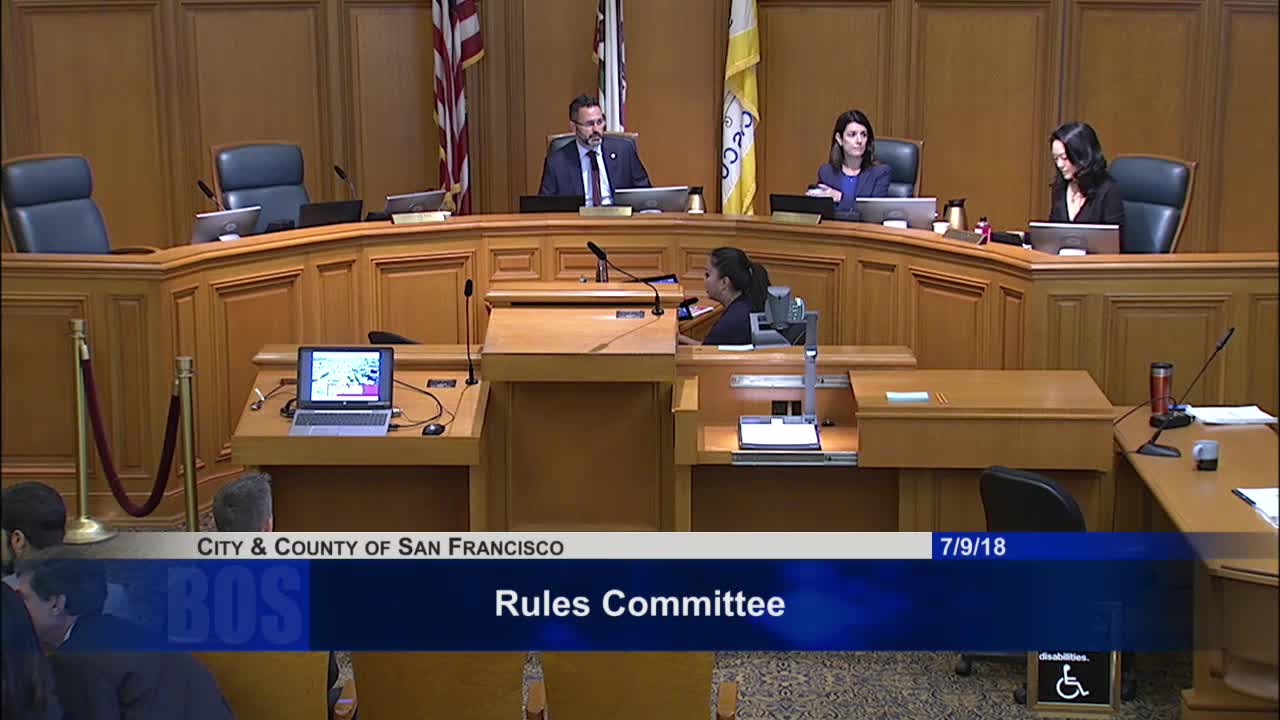
San Francisco The Board of SupervisorsRules Committee on July 9 referred a package of measures tied to the Central SoMa area plan to the Land Use Committee for detailed consideration, leaving the draft administrative-code changes and special-tax technical amendments without a recommendation at Rules.
Planning Department officials told the Rules Committee the Central SoMa plan would add roughly 16,000,000 square feet of development capacity, provide roughly 8,300 housing units and create a public benefits package the department estimates at about $2.2 billion over the plans buildout. Staff said the plan is designed to deliver 33 percent of residential units as permanently affordable housing and to preserve industrial and production, distribution and repair (PDR) space so there is no net loss of those uses.
The measures before Rules included amendments to administrative code section 35 intended to protect PDR and similar uses from spurious nuisance complaints as residential and hotel development comes into the area. Planning staff said the section 35 changes would add hotels to a list of uses that cannot bring frivolous nuisance claims against PDR operations that are in compliance with applicable permits and regulations, and would add disclosure procedures for buyers during property transfers to reduce later conflicts.
Also before the committee was a technical amendment to chapter 43 (the citys special tax financing law) so the subsequent Central SoMa special tax district could include additional eligible spending categoriesfor example, grants to nonprofits, certain sustainability investments, air quality studies and park programming. Staff explained the special tax (structured like a community facilities district under the Mello-Roos framework) would apply to larger condominium and nonresidential projects but exempt 100 percent affordable housing, BMR units, rental housing, PDR and community facilities.
Planning staff detailed funding priorities within the $2.2 billion package, saying the largest shares would go to affordable housing (nearly half of the package), transit (about $500 million), parks and recreation (about $185 million), PDR preservation ($180 million), complete streets ($110 million), community services and cultural preservation ($110 million), environmental sustainability ($70 million) and schools/childcare ($65 million). Staff said a mix of on-site contributions and development fees and taxes would fund the package and that certain revenues could be bonded to accelerate delivery.
Members of the public and neighborhood advocates weighed in during the Rules hearing. John Narperling asked who would be the final decision maker on spending from the proposed special tax district and urged a robust Citizens Advisory Committee; David Woo of the South of Market Community Action Network urged stronger up-front anti-displacement measures (land banking, acquisition of rent-controlled buildings, first right of refusal) and argued the plan as drafted risks gentrification and displacement; Christie Wong of SPUR urged urgency and cautioned that feasibility matters if fees are set too high.
Committee members pressed staff on multiple points: Supervisor Norman Yee asked how the plans projected 33,000 jobs and 8,300 housing units would affect the citys jobs-housing balance; staff and the sponsor, Supervisor Jane Kim, said the plan maximizes housing within what the environmental impact report (EIR) studied and noted that increasing housing beyond the EIRs scope would trigger a new EIR and delay adoption. Staff also described the plans public-open-space approach: roughly 1 acre of new publicly owned parkland plus about 3 acres of publicly accessible private open space (POPOS) for a combined approximate gain of 4 acres, with design and programming incentives to encourage child-friendly uses.
Chair Supervisor Asha Safaei and the sponsoring supervisor requested that items 1 and 2 be referred to the Land Use Committee for full review. Supervisor Yee moved to send the package to Land Use on July 16 without a recommendation from Rules; the committee agreed and the referral was made.
What happens next: The land-use hearing will consider the planning-code elements, the EIR implementation details and the special-tax district formation materials. The Land Use Committee will be the venue for detailed amendments, funding allocations and final policy language.
Sources: Planning Department presentation to Rules Committee; public comments at the July 9 Rules Committee hearing.