Get Full Government Meeting Transcripts, Videos, & Alerts Forever!
Get email alerts on the Safe Streets Bond topic
No spam. Unsubscribe anytime.
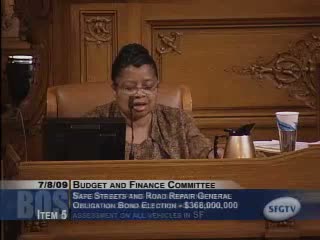
Committee forwards $368 million 'Safe Streets' bond to full Board while advocates press for stronger local‑hiring language
Summary
The committee moved forward a proposed $368 million general obligation bond for road resurfacing, sidewalks, curb ramps and streetscape improvements and agreed to duplicate the file so a second version with additional local‑hire reporting and compliance language can be developed; advocates urged mandatory local hiring, while the city attorney warned of legal limits.
The Budget & Finance Committee forwarded to the full Board a proposal to call a special election on a $368 million general obligation bond titled a "Safe Streets" and road‑repair bond, while agreeing to retain a duplicate file so the committee and the Board can consider an amended version that would strengthen local‑hire language and reporting.
The director of public works outlined the bond’s primary components: roughly $209 million dedicated to street resurfacing, about $93 million for streetscape improvements (pedestrian, bicycle and landscaping projects), and additional funds for sidewalks, curb ramps and other rights‑of‑way infrastructure. The director said the bond package is intended to enable an annual paving program in the range of $55–60 million combined with other state and local funds and to create multi‑year stability for infrastructure work that has been underfunded for decades. The ordinance requires a citizens’ GO Bond Oversight Committee, annual public reporting via a website and that the director of public works recommend funding strategies beyond the five‑year bond horizon.
Community advocates and supervisors pressed for enforceable local‑hiring terms. Supervisors (including David Campos and Carmen Chu) and numerous public commenters representing Southeast Jobs Coalition, Visitation Valley Jobs, the Living Wage Coalition and others urged mandatory percentages or firm reporting and enforcement mechanisms to ensure that a significant portion of bond‑funded work goes to San Francisco residents and minority contractors. Speakers argued the bond presents an opportunity to generate local jobs and apprenticeship placements for disadvantaged neighborhoods.
Deputy City Attorney cautioned that mandatory local‑hire ordinances have been challenged on constitutional grounds and that legally enforceable clauses could risk the measure; she and other staff suggested alternative approaches: stronger bid specifications, using administrative‑code authority (chapter 83/First Source hiring), requiring reporting to the Board, and adopting resolutions or contract provisions at the appropriation/issuance stage. Directors and staff proposed semiannual or annual written reporting by the responsible department on local‑hire outcomes and workforce development linkages.
To preserve options given tight ballot deadlines, the committee voted to duplicate the file: one version will be transmitted to the full Board on schedule and the other will be retained for amendment so a version with strengthened local‑hire language and reporting can be considered at the Board level. Committee members said they intend to return with reporting language and possible amendments but were reluctant to delay placing the bond on the November ballot.
The committee’s action sends a path to the ballot while leaving open further committee and Board actions to establish reporting and local‑hire mechanisms during subsequent appropriation and issuance steps. The full Board will decide which version proceeds to the ballot and how additional local‑hire or reporting language will be implemented during bond appropriation stages.