Get Full Government Meeting Transcripts, Videos, & Alerts Forever!
Get email alerts on the Dph Budget topic
No spam. Unsubscribe anytime.
Health department budget, fees and 'single standard of care' spark debate; Community Justice Center reports early use
Summary
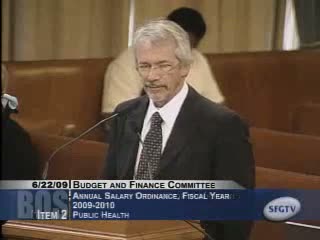
DPH outlined budget pressures, proposed patient-rate increases and fee items; the department's proposal to change indigent mental-health standards (the 'single standard of care' amendment) drew objections from advocates. The new Community Justice Center reported early patient contacts and on-site services.
Department of Public Health officials told the Budget & Finance Committee the department’s total budget is $1.447 billion, with hospitals accounting for $822 million and general fund support of approximately $319 million. DPH said it met much of its target through revenue increases and federal stimulus FMAP changes but still proposed limited reductions to direct services (about $12 million) and asked supervisors to consider restorations where possible.
Among the administrative items DPH proposed were annual patient-rate adjustments (used primarily to recover costs from insured and out-of-county patients) and new fee proposals for emergency medical services enforcement and a chain-restaurant menu-labeling enforcement fee (Rajeev Bhatia, environmental health, explained that the department would collect fees to enforce menu-label requirements now handled by the state, SEG 4400–4414). DPH also advanced a cigarette-litter abatement fee to recover cleanup costs; staff indicated the exact fee would return for follow-up committee review (SEG 4399–4440).
A more contentious proposal would amend the Administrative Code to change the city’s longstanding ‘‘single standard of care’’ for indigent mental-health patients so that services for non–serious mental illness would align with Medi-Cal eligibility and standards. Community advocates said the 2004 ordinance was intentionally broad to ensure parity for uninsured residents and warned the change could cut care for roughly 1,500 clients and shift costs and demand into higher-cost emergency services. Advocates urged the committee to reject any change that would reduce access (advocates’ comments, SEG 4555–4595; public commenters SEG 4569–4605).
Separately the new Community Justice Center at 555 Polk Street reported roughly 90 days of operations and more than 160 individuals served; DPH and court staff described on-site clinical services, probation partnerships and roving behavioral-health teams that serve clients both under and outside of justice mandates (Craig Murdoch, Tamika Moss, SEG 4741–4775). Supervisors asked for additional outcome data and a breakdown of capital and operating costs for the CJC at next week’s hearing.
What’s next: DPH and budget analysts will continue negotiations on recommended reductions and fee language; item 13 (cigarette-litter fee) and the single standard of care proposal were held for further discussion, with public comment recorded but no adoption. The committee asked staff to return with updated financials and performance measures before any ordinance votes.