Get Full Government Meeting Transcripts, Videos, & Alerts Forever!
Get email alerts on the Housing Evictions topic
No spam. Unsubscribe anytime.
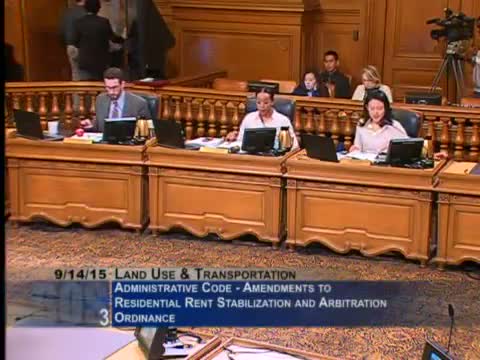
Committee votes to send revised ‘‘Eviction Protections 2’’ to full Board after hours of public comment and amendments
Summary
After a lengthy second hearing with more than 60 public speakers, the Land Use & Transportation Committee advanced an ordinance strengthening tenant protections, adopting amendments on nuisance language and a five‑year vacancy‑control limit, and voted separately to advance roommate/subletting provisions to the full Board.
The Land Use & Transportation Committee advanced an ordinance known as Eviction Protections 2 to the full Board on Tuesday after a marathon second hearing and hours of public comment that split landlords and tenants.
Supervisor Jane Kim, who sponsored the measure, framed the package as a response to a surge in evictions and a tool to reduce displacement among vulnerable residents. Kim cited Rent Board data in the hearing: “there were 2,122 notices of eviction filed with the rent board over the year ending 02/28/2015,” she said, and noted that represented a sharp increase over several years. Kim told the committee the ordinance requires multilingual eviction notices (including Chinese, Vietnamese, Tagalog and Russian), provides tenants a chance to cure certain minor violations, clarifies protections for tenants in units that were illegally converted, and codifies vacancy‑control provisions consistent with state law.
The committee heard testimony from a large and diverse public turnout. Tenant organizations and service providers—including Just Cause, Tenderloin Neighborhood Development Corporation, Mission SRO Collective, Jobs with Justice and Senior and Disability Action—urged passage, citing stories of alleged sham evictions, the loss of affordable units and harm to seniors and people with disabilities. “This bill must pass,” said Sheena Gupta of the Mission SRO Collaborative during public comment.
Small property owners and landlord groups opposed portions of the ordinance, saying some provisions would be overly punitive and would discourage owners from renting. Several speakers described property damage, unpaid rent and heavy legal costs; one speaker warned the ordinance would force small owners to shoulder a perpetual financial burden. The hearing record shows strong, often emotional disagreement about how to balance tenant stability and owner rights.
Supervisors debated proposed amendments. Supervisor Malia Cohen proposed a technical amendment clarifying that nothing in the legislation would prevent a landlord from recovering possession under certain existing rent‑ordinance sections (37.9a, subsections 8 and 10) intended to address eliminated or uninhabitable illegal units; Cohen said the change would preserve landlords’ ability to address unsafe illegal units while ensuring relocation assistance where required.
Supervisor Scott Wiener successfully moved two substantive changes: tightening the nuisance standard so that a nuisance eviction requires activity that is “severe, continuing, or recurring,” and limiting the vacancy‑control (Costa‑Hawkins related) consequence to five years following a qualifying termination rather than making vacancy control indefinite in perpetuity. Wiener argued the latter amendment aligns the local rule with reasonable time periods and avoids perverse incentives. A separate Wiener motion to remove broad subletting restrictions (language that would have prevented landlords from enforcing many lease subletting restrictions) failed by roll call.
After dividing the ordinance for voting, the committee first advanced the main ordinance (minus the roommate/subletting section) to the full Board with a positive recommendation. The committee then considered the roommate/subletting language separately; that section also passed on a 2–1 roll‑call vote (Supervisor Kim and Chair Cohen supporting, Supervisor Wiener opposed) and will be included when the ordinance goes to the full Board.
The committee vote sends the ordinance—now amended for nuisance language, a five‑year vacancy‑control limit and a clarified technical exemption for unsafe illegal units—to the full Board for final consideration. The measure will likely return to the Board with heavy public interest and additional opportunities for amendment.
What’s next: the ordinance, as amended in committee, will be scheduled for full Board consideration. The hearing record shows significant cross‑stakeholder disagreement that may prompt further edits at the Board stage.