Get Full Government Meeting Transcripts, Videos, & Alerts Forever!
Get email alerts on the Propj Contracting topic
No spam. Unsubscribe anytime.
Supervisors Hear Strong Opposition to Mayor’s Plan to Outsource Museum, Hospital and City Building Security
Summary
Supervisors heard department presentations saying contracting could halve security/custodial costs and dozens of public comments urging them not to privatize custodial and security jobs. Committee continued Prop J items for further review after widespread testimony about safety, training and job losses.
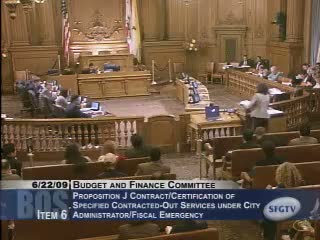
The Budget and Finance Committee on Monday debated a package of Prop J resolutions that would let the city contract custodial and security services at dozens of public buildings, museums and hospitals to private firms to meet the mayor’s budget targets. Chair Supervisor John Avalos opened the hearing and called departments to present the fiscal and operational rationale.
Amy Brown, director of real estate and deputy city administrator, told the committee the city’s experience with six existing Prop J custodial contracts shows private contractors can provide custodial services “at about half the cost” of city employees. She said the current proposal would add 34 buildings to the contracts and estimated annualized savings of roughly $3.96 million to $5.15 million (Amy Brown, SEG 063–083). Brown said the change follows a facilities-management consolidation intended to let the city flex staffing across buildings.
Museum officials said the same pressures drove their positions. Jay Xu, director of the Asian Art Museum, introduced CFO Mark McLaughlin, who said outsourcing would allow the museum to meet targeted reductions and “save the Museum approximately half the cost of our current security force.” McLaughlin described an elimination of 31.75 FTEs in the museum’s security budget and said the proposal would leave a security director and three supervisors as city employees (Mark McLaughlin, SEG 115–133).
Greg Sass, the Department of Public Health’s chief finance officer, described the proposal for institutional police and sheriff staffing at San Francisco General Hospital, Laguna Honda Hospital and city clinics: DPH is seeking to reduce overtime and the costs of using sheriff deputies and institutional police and projects roughly $3 million in annual savings if private security is contracted for those posts beginning January 1 (Greg Sass, SEG 196–216).
Supervisors pressed departments on safety and training. Supervisor David Campos asked whether private security would have the same level of training and accountability as sworn deputies; DPH and institutional police representatives said training differs but that hospitals could require health-care-specific certifications and that any contracted guards would need an MOU with SFPD for arrest authority and that some contracted guards could be armed (Del Vecchio, institutional police, SEG 372–383; Greg Sass, SEG 277–284).
Public comment ran for hours and focused overwhelmingly on safety, jobs and specialized training. Institutional police officers, nurses, museum guards and union representatives told the committee the city would be “deskilling” critical services and risking safety for patients, visitors and priceless art. SEIU member Robert Holland said the plan amounted to “deskilling” and warned private contractors would not provide better service: “you're getting service for profit, but you're not getting better service” (Robert Holland, SEG 742–749). Institutional police and custodial staff described decades of on-site experience, hospital accreditation requirements and low incidence of critical incidents under the current model (George Gong, SEG 885–924; Michael Tong, SEG 804–816).
Fine Arts Museums and Asian Art Museum officials acknowledged the hardship for staff and said the Foundation’s operating and bond pressures limited the museum’s options; the Asian Art Museum’s foundation was described as facing a multi-million-dollar operating shortfall and refinancing stress (Jay Xu, SEG 2140–2150).
With the arguments aired, Supervisor McRamey moved to continue the Prop J items so the committee could consider the testimony and return with additional information; the motion was seconded and the items were continued to a later hearing (motion to continue, SEG 2058–2064).
What’s next: The committee continued Prop J items to the call of the chair; staff told the board they would compile additional information on redeployment of sworn staff, details on MOUs with SFPD, and building-by-building savings and staffing plans before the next hearing.