Get Full Government Meeting Transcripts, Videos, & Alerts Forever!
Get email alerts on the Public Safety Budgets topic
No spam. Unsubscribe anytime.
Police, fire and sheriff outline trade-offs: hiring, civilianization, station coverage and security contracting
Summary
Department leaders explained how recent hiring pushed staffing toward charter goals, how civilianization has been limited by midyear freezes, and how proposed security contracting or deep interim cuts would force layoffs or station closures; police described a PERF pilot at Ingleside to shift patrol time toward community policing.
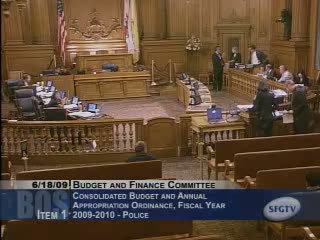
Police, fire and sheriff departments used committee hearings on June 18 to walk supervisors through granular trade-offs between personnel, civilianization and service coverage.
Police: Chief Chi Fong said the department—s budget remains dominated by personnel costs (about 90%) and that the department has reduced overtime and slowed academy hiring in the short term. He emphasized a recent surge in recruits that brought sworn staffing near the charter-mandated level and described the PERF (Police Executive Research Forum) pilot at Ingleside Station, where the department is testing crime-analytic staffing and rebalancing patrol time toward community problem-solving. Ken Bukowski, SFPD CFO, said the department had civilianized many positions but midyear freezes and vacant posts have stalled further civilianization: "Of 123 positions identified for civilianization, 72 have been filled; 33 were deleted for 2009-10," he reported.
Fire: Chief Ace Hayes White and the budget analyst debated response-time impacts of station brownouts and equipment reductions. Fire leadership warned that removing an engine or truck will lengthen 90th-percentile response times in specific neighborhoods; the department provided station-level simulations showing increases of one to two-and-a-half minutes in some places if certain low-volume units were removed. Budget staff referenced a 2002/2004 controller analysis on station coverage and suggested some options for reconfiguration; supervisors asked for updated, systemwide simulation data before any vote.
Sheriff: Sheriff Michael Hennessy emphasized the conditional nature of his budget: mayoral Prop Js to contract security would reduce his operating burden and lead to contractor staffing in the second half of FY10, but if supervisors reject those Props he said restoring security in hospital, city hall and other sites would require roughly $12.1 million in added appropriation and would avoid the layoff of about 77 non-deputy staff (cadets, institutional officers, dispatchers). Hennessy also told the committee that a hypothetical $17 million interim cut the Controller floated would force closure of two jails and reduce system capacity by about 33%, requiring early-release or graduated-release programs to remain within legal capacity.
Supervisors pressed for more reconciled modeling and incremental options. Budget analysts and department finance officers were asked to return with station-by-station response-time models, the cost and revenue math for 10b (private-detail) administrative fees, civilianization roll-up, and precise layoff rosters tied to each contracting scenario. The committee did not adopt final cuts at the June 18 hearing and scheduled follow-ups.