Get Full Government Meeting Transcripts, Videos, & Alerts Forever!
Get email alerts on the Criminal Justice topic
No spam. Unsubscribe anytime.
Rules committee forwards San Francisco ordinance to abolish many criminal‑justice fees to budget subcommittee
Summary
The Rules Committee advanced legislation introduced by Board President London Breed that would eliminate locally authorized criminal‑justice administrative fees. Speakers including Public Defender Jeff Adachi and the treasurer's Financial Justice Project argued the fees are costly to collect and disproportionately harm low‑income residents; the measure is referred to the budget subcommittee for fiscal analysis on May 10.
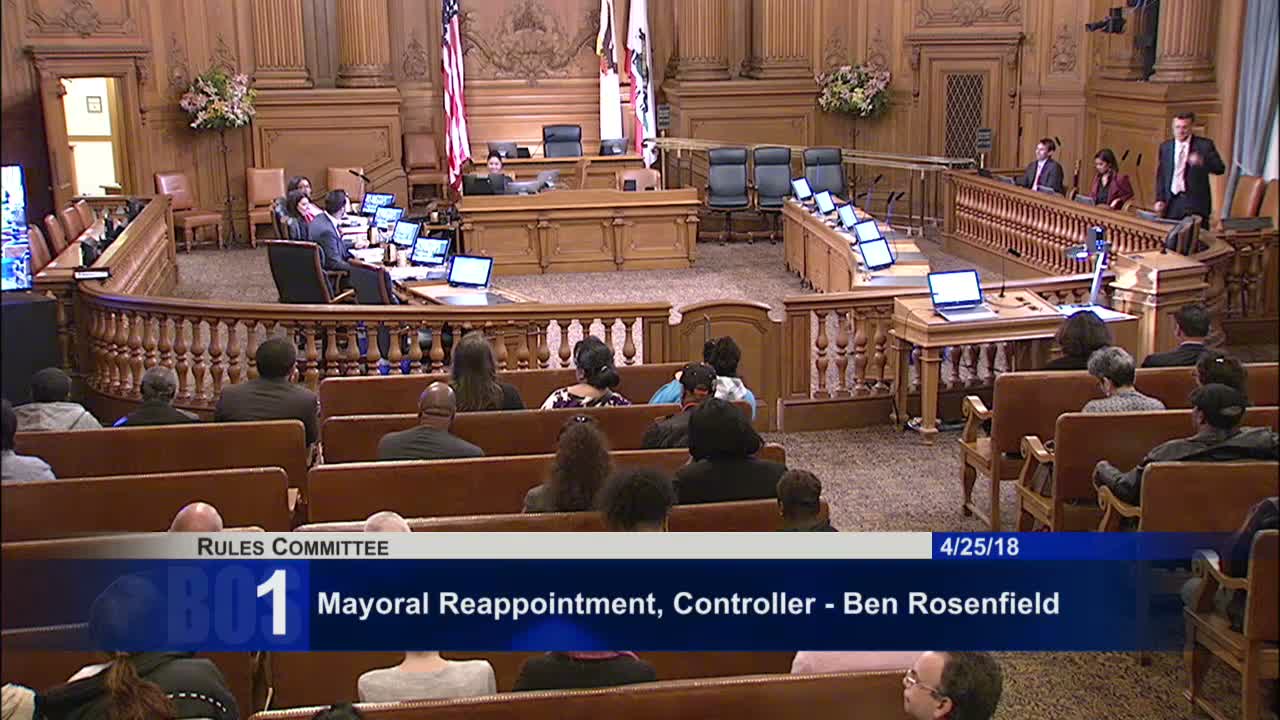
The Rules Committee on April 25 considered a proposed ordinance to amend the administrative code to abolish a wide range of criminal‑justice administrative fees levied by the city — including probation costs, booking fees, home‑detention charges and penalties tied to alcohol testing and certain offenses.
Board President London Breed, the ordinance sponsor, said San Francisco could become the first U.S. city to eliminate these locally authorized fees, which she described as barriers to reentry that disproportionately affect communities of color. Breed said task‑force work and coordination with the courts, probation and other agencies identified the fees and recommended elimination of city‑authorized charges.
Public Defender Jeff Adachi presented data and client stories, arguing that fines and fees can trap people in cycles of punishment and poverty. Anne Stuhldreher of the treasurer’s Financial Justice Project gave the committee collection and fiscal figures: an average collection rate of about 17% across the fees studied over five years, and as low as 9% for the largest monthly probation fee in 2016. Stuhldreher estimated the city would forgo roughly $1 million a year in revenue if the fees were abolished, while eliminating outstanding fee debt would lift an estimated $15 million in liabilities from about 20,000 individuals.
Dozens of community organizations, legal aid groups, formerly incarcerated people and residents provided public comment in support of abolition, describing harms to housing stability, employment and recidivism risks. Speakers included Debt Free San Francisco, the Coalition on Homelessness, Legal Services for Prisoners with Children, the Human Rights Commission and probation and sheriffs’ staff who participated in the task force.
Committee members repeatedly flagged fiscal concerns and implementation details, including how to notify people who are currently paying combined checks and how departments would cease collections. The ordinance’s sponsor and staff agreed to refer the ordinance to the Board’s budget subcommittee for a detailed fiscal review on May 10, where the mayor’s budget office, the legislative analysts and the controller’s office will be present. The committee added a positive recommendation to move the ordinance forward while reserving the fiscal questions for the budget hearing.
What happens next: The ordinance will be heard by the budget subcommittee on May 10 for fiscal analysis, after which it will return to the full board process.