Get Full Government Meeting Transcripts, Videos, & Alerts Forever!
Get email alerts on the Short Term Rentals Regulation topic
No spam. Unsubscribe anytime.
San Francisco committee advances competing short-term rental bills after days-long debate
Summary
The Land Use & Transportation Committee heard competing ordinances to limit short-term rentals, received analyses from Planning, the Budget & Legislative Analyst and the Office of Economic Analysis, and voted to send two revised proposals to the full Board for June 9 consideration after approving one amendment in committee.
San Francisco supervisors on the Land Use & Transportation Committee on May 21 advanced competing proposals to limit short-term rentals, sending two revised ordinances to the full Board of Supervisors for consideration on June 9 after a day of presentations and more than three hours of public comment.
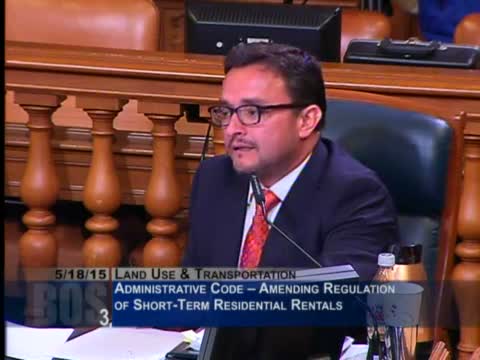
Supervisor David Campos, the author of one bill, urged colleagues to adopt an enforced 60-night cap on short-term rentals and to empower enforcement by requiring hosting platforms to list only registered units and to provide booking data to the city. Campos said a recent Budget and Legislative Analyst report shows "Airbnb is having a significant impact on the housing market, taking up as, somewhere between 1,302,000 entire units off the housing market in the city and county of San Francisco," and argued the city needed stronger penalties and a private right of action to hold bad actors accountable.
Supporters of a different package led by Mayor Ed Lee and Supervisor Mark Farrell proposed a 120-night hard cap, elimination of the distinction between hosted and unhosted rentals, and creation of an Office of Short-Term Rental Administration to streamline registration and enforcement. Farrell said the office would centralize intake and enforcement across planning, tax, and building departments so residents who want to comply could do so more easily.
Planning Department staff and the Planning Commission recommended several changes to the February law that took effect about 100 days earlier: the commission supported raising the cap to 120 nights, removing the hosted/unhosted distinction and prohibiting units subject to recent Ellis Act evictions from listing for five years. The commission declined to require platforms to refuse listings for units not registered with the city, and it did not recommend mandatory quarterly booking reports from registries.
The Budget and Legislative Analyst (BLA) and the ControllerOffice of Economic Analysis presented contrasting but related analyses. The BLA used web-scraped Airbnb data and a reviews-to-bookings formula to create low, medium and high impact scenarios; under its medium scenario it estimated roughly 1,251 "commercial" entire-unit listings and said a 60-night cap would affect a larger number of listings than a 120-night cap. BLA analysts emphasized limitations of the available data and said the numbers should be treated as estimates rather than precise counts.
The Office of Economic Analysis compared short-term daily revenue with market rents and concluded both a 60-day and a 120-day cap would likely reduce the incentive for a vacant unit to be used full time as a short-term rental; the office framed the tradeoff between the host and visitor economic benefits and the economic cost if housing is permanently removed from the long-term market.
Supervisors asked planning and analysts pointed questions about enforceability. Planning staff told the committee that booking data from platforms would help enforcement but was not the only way to identify violations; options cited include web-scraping, technical tools, neighbor complaints, targeted investigations and audits tied to registration renewals. Planning staff said they had received more than 600 registration applications and issued several hundred certificates but had limited enforcement staffing and were still improving intake procedures.
Public comment stretched for hours. Hosts and neighborhood businesses described hosting as an essential income source that helps them stay in the city and directs tourist spending to non-downtown neighborhoods. Tenant advocates, neighborhood groups and housing-rights organizations said short-term rentals can accelerate displacement and urged stronger enforcement tools, data sharing from platforms and penalties that would make the platforms accountable for unregistered listings.
Committee action: Supervisor Campos moved an amendment shortening the waiting period after an interested-party complaint from 60 to 30 days; the amendment was accepted in committee. The committee then voted to forward Supervisor Campos' ordinance as amended to the full Board on June 9 without a recommendation (roll call: Campos Aye; Wiener No; Cohen Aye). The Mayor/Farrell ordinance and technical amendments were also forwarded to the Board on June 9 without recommendation in a separate vote (unanimous). The committee did not pass a final cap or enforcement policy in committee; instead it sent competing approaches to the full Board for resolution.
What happens next: Both ordinances (and any adopted committee amendments) are scheduled for full Board consideration on June 9. Supervisors and staff said the record and public comment will continue to inform deliberations; several speakers urged stronger data access by the city, while others urged caution to avoid cutting off income that homeowners and small businesses currently rely on.