Get Full Government Meeting Transcripts, Videos, & Alerts Forever!
Get email alerts on the Puc Charter Amendment topic
No spam. Unsubscribe anytime.
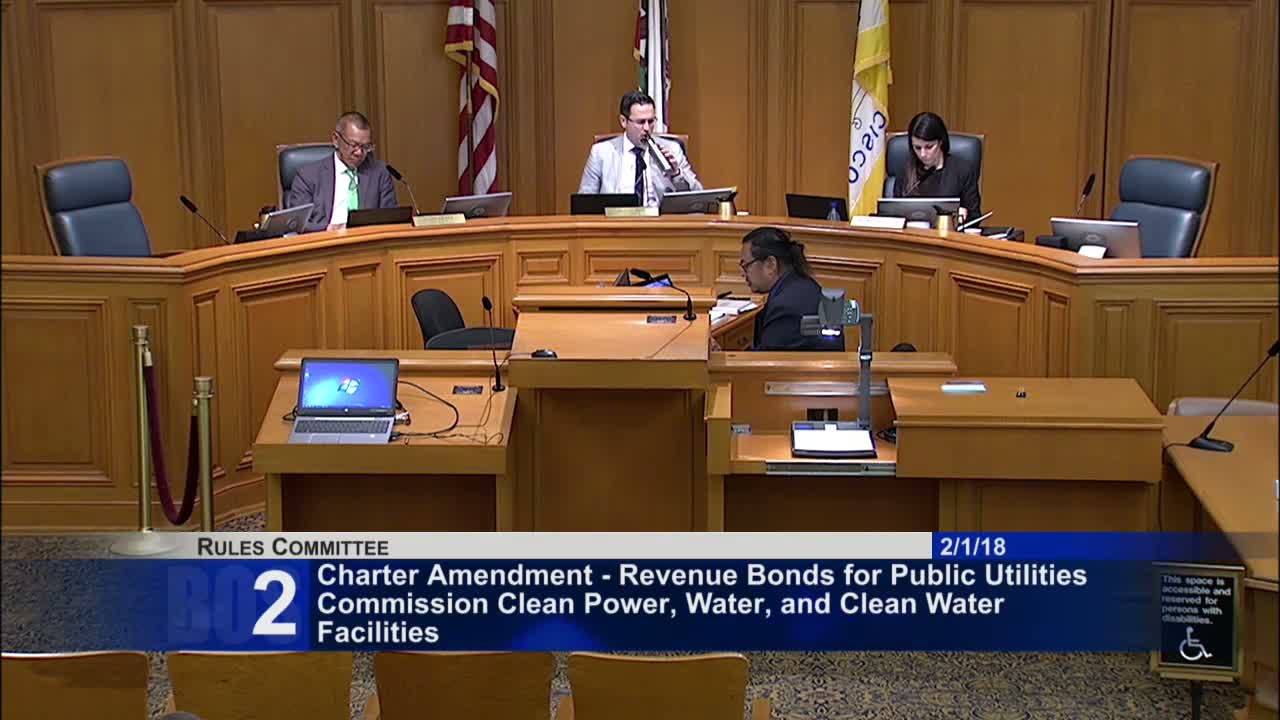
Rules Committee backs charter amendment to let PUC issue revenue bonds for power facilities
Summary
The Rules Committee on Feb. 1 recommended the Board send a charter amendment to voters that would authorize the Public Utilities Commission to issue revenue bonds for certain power facilities if approved by ordinance and a two-thirds Board vote.
SAN FRANCISCO — The Rules Committee voted Feb. 1 to forward a charter amendment that would allow the Public Utilities Commission to issue revenue bonds to finance certain power facilities, sending the measure to the full Board of Supervisors with a positive recommendation as a committee report.
Barbara Hale, Assistant General Manager for Power at the Public Utilities Commission, summarized the amendment to the committee: “This charter amendment would allow the public utilities commission to issue revenue bonds for facilities that are needed to produce and deliver clean energy,” she said, adding that the authority would apply only after the facilities had been approved by ordinance and received “a two-thirds vote of the Board of Supervisors.”
Hale told the committee the authority would expand the PUC’s existing ability to use revenue financing for improvements to existing facilities and would align power with the water and wastewater enterprises, which already have similar revenue-bond authority. She listed potential uses such as distribution facilities to serve new customers, electric-vehicle charging stations and on‑site generation.
Committee members asked whether the amendment would limit financing to strictly “clean power” projects and for concrete examples of covered facilities; Hale said the amendment is intended to permit power-related investments that benefit power, water or wastewater customers when consistent with existing law and subject to Board review and the existing revenue bond oversight structure.
The committee discussed scheduling and whether the amendment should go out on the regular ballot schedule rather than as a late charter amendment. Staff advised that if the Board intends the measure to go on the regular schedule it must be transmitted as a committee report; a committee member moved to send the measure to the full Board with a positive recommendation as a committee report, and the chair announced the item was ordered and approved without objection.
The committee’s action forwards the amendment to the Board; any placement on the ballot and final approvals will follow Board procedures.