Get Full Government Meeting Transcripts, Videos, & Alerts Forever!
Get email alerts on the Human Services Hud Grants topic
No spam. Unsubscribe anytime.
County human‑services briefing outlines rising demand and HUD grant allocations; supervisors press for neighborhood equity
Summary
A statewide human‑services report presented county-level caseload increases, economic multipliers for assistance spending, and a local estimate that San Francisco’s share of statewide shortfall is about $31 million. The committee also considered three HUD grant resolutions (CDBG, ESG, HOME) and questioned neighborhood coverage and nonprofit capacity.
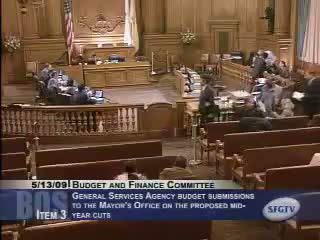
A county-level human‑services briefing and a set of HUD grant resolutions were heard together by the Board’s Full Budget Committee, which focused on rising caseloads, local general‑fund exposure and neighborhood coverage of federal formula grants.
Trent Rohrer (presenting a report prepared with the California State Association of Counties and the County Welfare Directors Association) told the committee statewide unemployment in March 2009 was approximately 11.5% and San Francisco’s unemployment was about 9%. Beacon Economics analysis, commissioned alongside the report, estimated a conservative $1.32 in local economic activity for every dollar spent on human-services assistance (food stamps, CalWORKs, general assistance).
Rohrer said food‑stamp applications had grown rapidly (quarterly applications up ~16%), CalWORKs and County Adult Assistance Program (CAP) applications were also rising, and CAP payments are funded 100% from the general fund—making increases an immediate local budget exposure. He estimated San Francisco’s share of the statewide human-services funding shortfall at about $31 million annually. The presentation urged active state-level advocacy to speed federal stimulus/TANF funds to counties and noted that certain eligibility rules (for example, CalWORKs resource limits) constrain rapid caseload growth but will shift when unemployment benefits end.
Committee members raised neighborhood-equity concerns during the HUD-grants section. The clerk called three resolutions (Item 5 CDBG $21,092,426; Item 6 Emergency Shelter Grant $938,867; Item 7 HOME $8,602,628). Brian Chu (Mayor’s Office) explained modest allocation increases allowed the mayor’s office to restore or modestly increase awards to some mission-area workforce-development providers and small-business assistance organizations (examples included Mission Hiring Hall and Mission Language and Vocational Services). Budget analyst Harvey Rose flagged $1,627,329 in new or increased non-capital awards as policy matters for the Board and otherwise recommended approval.
Supervisors pressed for neighborhood coverage. Supervisor McRaney and others noted the absence (in the printed allocations) of some organizations they helped preserve last year (Ella Hill Hutch missed the application deadline and therefore did not appear on the CDBG list). Supervisors from western neighborhoods urged targeted RFPs or reprogramming of unspent funds to preserve services in areas with limited nonprofit capacity; Mayor’s Office staff offered options including targeted reprocurements and using canceled/unspent project funds to preserve critical services.
Public commenters echoed supervisors’ concerns, urging that domestic-violence providers and neighborhood workforce programs not be cut as caseloads rise.
Outcome: The committee voted to forward the HUD accept-and-expend resolutions to the full Board with the committee’s recommendations. Staff noted HUD granted an extension to June 1 to finalize the consolidated plan changes and the Mayor’s Office said it would continue outreach to affected neighborhoods to identify gaps and potential reprogramming options.