Get Full Government Meeting Transcripts, Videos, & Alerts Forever!
Get email alerts on the Massage Regulation topic
No spam. Unsubscribe anytime.
San Francisco committee advances ordinances to tighten rules for massage businesses, citing human‑trafficking concerns
Summary
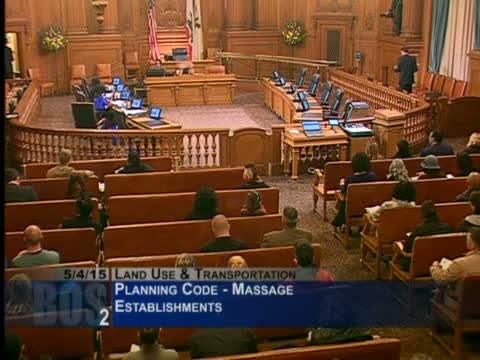
The Land Use & Transportation Committee voted unanimously to send Supervisor Katie Tang’s paired health‑code and planning‑code ordinances to the full Board, removing the CMTC exemption, requiring DPH establishment permits, creating a time‑limited legitimization (amnesty) program, and reinstating conditional‑use controls for many new massage businesses.
The Land Use & Transportation Committee on May 5 voted to send paired ordinances from Supervisor Katie Tang to the full Board of Supervisors that would remove the California Massage Therapy Council (CMTC) exemption and require Department of Public Health (DPH) establishment permits for all massage businesses in San Francisco. The committee also approved a time‑limited legitimization (amnesty) program allowing existing unpermitted operations to apply for DPH permits while continuing to operate during review.
Supervisor Katie Tang framed the bills as a restoration of local authority eroded by state law and a tool to address illicit operations. “So now, if you are, employing all CAMTC therapists, we’re gonna require that you do obtain a DPH business permit,” Tang said, explaining the ordinances’ major change to local permitting practice.
The measures respond to data and enforcement concerns presented by DPH staff. Cindy Comerford of the Department of Public Health told the committee the city “We currently have 2 36 massage establishments, that we know of operating in San Francisco,” and that DPH estimates a substantial share of establishments open under the CMTC exemption have produced enforcement problems, clustered in seven neighborhoods. DPH described repeated closures and re‑openings and said the legitimization program would allow eligible businesses to apply for permits within 90 days of the ordinance’s effective date and be treated as legal nonconforming uses while their applications are processed; the program is scheduled to sunset after 18 months.
The Planning Department presented seven recommendations, including a three‑year review of compliance for approved establishments and a three‑year prohibition on reopening a location that had been closed for violations. The ordinances also include an exemption for sole practitioners and an expansion allowing up to four sole practitioners to co‑locate without a conditional‑use (CU) requirement.
Supporters — including members of the mayor’s anti‑human‑trafficking task force and the Commission on the Status of Women — said the changes are an important enforcement tool. “I urge you to support these important changes to eradicate human trafficking from our massage establishments in San Francisco,” said Dr. Emily Murase of the Department on the Status of Women.
Industry groups and many licensed practitioners urged caution, saying the conditional‑use process and new fees could impose outsized costs and barriers on legitimate small businesses and sole practitioners. “The conditional use that is the barrier to entry that is being proposed is not that fail safe,” said Amanda Lightner, a local massage therapist, arguing the new framework could push legitimate providers out of the city.
Committee members agreed to two parallel tracks to balance rapid action and further refinement: the committee duplicated the file so Tang’s original set of ordinances could be forwarded to the full board with a positive recommendation while a duplicate copy remains in committee for “trailing” legislation to address issues such as expedited CU processing, relocation rules for existing businesses that move, and co‑location with other health practitioners. Supervisor Scott Wiener asked departments to provide formal recommendations on an expedited CU pathway and on whether moving businesses in good standing could avoid a full CU.
The committee voted unanimously to forward items 1 and 2 to the full Board with a positive recommendation; the committee also accepted a technical clarification to the planning‑code definition to preserve language acknowledging massage as a health‑related service in the code.
What’s next: the full Board of Supervisors will consider the ordinances at a forthcoming meeting; the committee retained a duplicate of the file to draft and circulate follow‑up legislation to address practical implementation concerns raised by practitioners and small‑business advocates.