Get Full Government Meeting Transcripts, Videos, & Alerts Forever!
Get email alerts on the Cannabis Regulation topic
No spam. Unsubscribe anytime.
San Francisco rules committee advances sweeping cannabis ordinance; equity, portability and on-site consumption amendments approved
Summary
The Rules Committee advanced an ordinance to regulate commercial cannabis activity, adopting amendments on equity eligibility, temporary/portable permits, a two-step registration for existing operators and DPH-guided on-site consumption standards; the item was continued for final drafting.
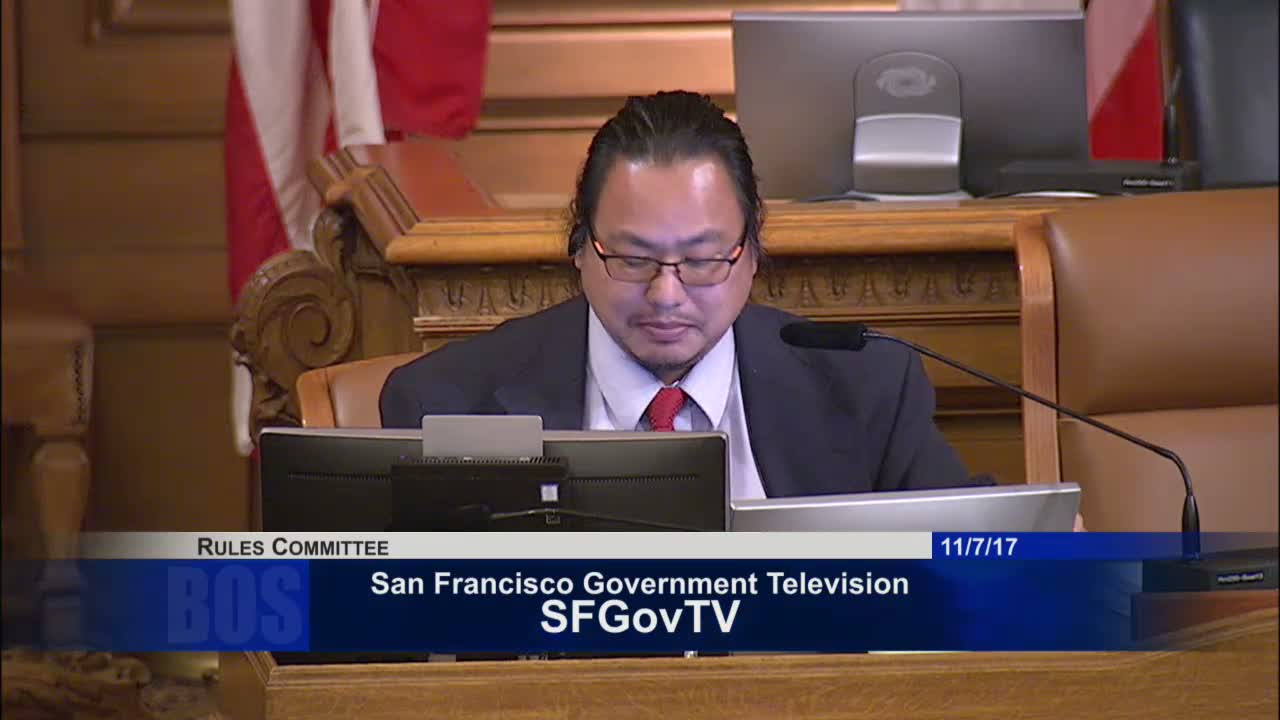
The San Francisco Board of Supervisors Rules Committee met on Nov. 7, 2017, to consider a citywide ordinance to regulate commercial cannabis activities and adopted a package of policy and technical amendments while continuing the item for final drafting.
Supervisor Malia Cohen, who sponsored equity provisions, told the committee she had circulated written amendments designed to "ensure full and equal access to opportunities" for communities harmed by the war on drugs and to align conviction‑history criteria with the city’s Fair Chance Ordinance. Cohen said she would "change the conviction history criteria" to reference subsection 5(b) and track police code section 49.04 so applicants with qualifying arrests or convictions between 1971 and 02/2009 could be eligible for the equity program.
The committee discussed a portability amendment intended to prevent landlords from capturing the value of permitted businesses. Chair and sponsors described a mobile permit that would allow a permittee to retain eligibility and relocate for up to 18 months provided there was no change in ownership and departments complete required reviews. Deputy City Attorney John Gibner advised that drafting to reconcile that concept with planning‑code conditional‑use rules would require trailing legislation and, potentially, referral to the Planning Commission.
Supervisor Jane Feuer introduced a two‑step registration process for existing nonconforming operators. Under the amendment, operators that can prove business existence by a specified date would register and sign an affidavit promising not to operate from an unauthorized location; after they secure appropriately zoned space they would receive priority processing for a full permit. Feuer also urged creation of a Community Impact Fund to direct future cannabis tax revenue to communities most affected by past enforcement.
Supervisor Jeff Sheehy presented amendments allowing limited on‑site consumption subject to Department of Public Health (DPH) standards: designated smoking rooms with separate HVAC, filtration, self‑closing doors, and worker safety safeguards. DPH staff told the committee that the eight currently operating medical cannabis dispensaries that permit on‑site consumption would be required to meet ventilation standards but that some small existing locations might not meet a separate‑room requirement; the committee directed city attorneys and DPH to draft language to account for existing sites while applying stricter standards to new permits.
Public comment ran for more than three hours. Labor unions (Laborers Local 261 and Teamsters) urged apprenticeship and local‑hire provisions. Industry and community commenters—including pipeline applicants, delivery operators and equity‑working‑group members—pressed the board to reduce school proximity buffers (many urged 600 feet or 500 feet instead of 1,000 feet), extend registration deadlines for preexisting operators, and include federally closed dispensaries in priority lists. Multiple speakers emphasized access to capital, the ownership thresholds in equity rules, and protections against outside investors buying local permits.
Motions to adopt the portability amendment, the two‑step registration approach, on‑site‑consumption language (with follow‑up drafting for specific exemptions) and the equity clarifications were made and accepted "without objection" during the meeting. The committee instructed city attorneys to produce a consolidated, clean version of the ordinance with trailing legislation to resolve planning‑code and drafting details. The matter was continued to the call of the chair so that final language can be prepared for the full board.
What happens next: staff and the city attorney will finalize the ordinance text and trailing amendments (including specific language to accommodate certain existing on‑site consumption sites and to reconcile portability with planning code), then the committee will reconvene to consider the clean draft before forwarding the ordinance to the full Board of Supervisors.