Get Full Government Meeting Transcripts, Videos, & Alerts Forever!
Get email alerts on the Mta Budget topic
No spam. Unsubscribe anytime.
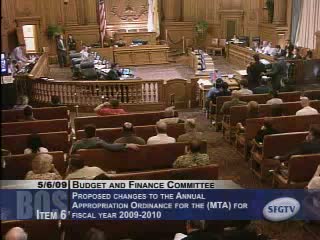
MTA proposes fare increases, service cuts and reserve for taxi medallions; supervisors refer rejection motion to full Board
Summary
MTA staff told supervisors of $80'$90 million of revenue loss and an amended FY2010 plan that balanced with about $90 million in spending reductions, fare increases (single-ride $1.50 to $2.00, discount and monthly pass increases) and $13.4 million in service reductions; Board President Carmen Chu's motion to reject the MTA budget was referred to the full Board after committee debate and extensive public testimony.
The Municipal Transportation Agency presented an amended FY2010 budget on May 6 that sought to close a major revenue gap created by state and general-fund declines and higher-than-expected costs.
Nat Ford, representing MTA leadership, said the agency had lost roughly $80'$90 million in revenue since last year's two-year budget and proposed a combination of revenue actions, reserve use and spending cuts to balance the year. MTA staff said they had reduced projected work orders to other city departments from roughly $80 million to about $66 million and proposed using reserves and personnel reductions to bridge the gap.
Sonali Oka, MTA finance director, and Julie Kirschbaum, service planning lead, laid out the agency's balancing package: elimination of about 456 positions (370+ positions cited in some slides), conversion and reallocation of other operator positions, $13.4 million in service modifications and reductions (including elimination or truncation of several routes), and a set of fee and fare proposals intended to raise operating revenue. The single-ride cash fare was proposed to increase from $1.50 to $2.00; discount single fares and several pass products were also proposed for increases, and a premium BART-Muni monthly pass was proposed to offset BART interagency costs. MTA also included a $15,000,000 taxi-medallion line as a potential revenue source and reserved expenditures against that amount pending further mechanics.
Supervisors asked detailed questions about the MTA's work orders (historically rising from about $45.46M in FY2007 to roughly $78M in the current year), the $7M payment to the city's 3-1-1 center (about 60% attributable to Muni calls), police work orders and an audit of the proof-of-payment enforcement program. The Budget Analyst and Controller said they are completing audits and analyses; the Budget Analyst reported a proof-of-payment program budget of about $8.8M with fine revenue far smaller in recent months (six-month fine collections ~ $350,000), and recommended holding expansion until program effectiveness and deployment issues are addressed.
Public comment was extensive and contested. Low-income riders, senior advocates and community organizations pressed supervisors to reject fare increases and service cuts that affect vulnerable neighborhoods. Transit advocacy groups urged rejection of the budget and deeper cuts to non-transit work orders and reallocation of parking and meter policy. Taxi drivers and medallion holders opposed any sale or corporate transferability of medallions (Prop K protections) and warned such moves would harm driver livelihoods.
Committee action and next steps: President Carmen Chu introduced a resolution to reject the MTA budget and asked MTA staff to take another pass at assumptions. After debate the committee voted to refer the rejection motion to the full Board with a recommendation and asked the MTA to return any revised material promptly; the vote in committee was recorded as 4 ayes, 1 no. Controller and Budget Analyst offices committed to completing audits (work orders and proof-of-payment) and continuing oversight.
Why it matters: The MTA budget includes proposals that affect fares, service coverage, and citywide interagency payments; supervisors and the public raised concerns about the distribution of service impacts (disadvantaged neighborhoods, public-housing transit access) and the fairness of potential revenue shifts (work orders and taxi-medallion revenue). Rejecting the budget would trigger interim appropriation questions under the charter and require the parties to resolve funding and service paths quickly.
Representative quote: MTA staff told the committee, "We have eliminated nearly 500 positions," and the controller cautioned officials that the city's revenue outlook remains uncertain.
Ending: The committee referred the rejection motion to the full Board, urged MTA staff to revisit assumptions and directed audits of work orders and enforcement programs; supervisors emphasized equity and transparency as the process continues.