Get Full Government Meeting Transcripts, Videos, & Alerts Forever!
Get email alerts on the City Budget topic
No spam. Unsubscribe anytime.
Supervisors hear grim budget outlook; departments outline deep cuts and children's services reductions
Summary
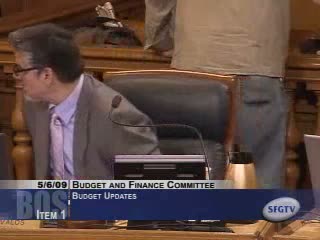
At a May 6, 2009 Budget & Finance Committee hearing, the mayor's budget office and controller presented a $438.1 million joint shortfall and a 9-month report showing $10.8 million in current-year revenue weakness offset by federal stimulus funds; departments outlined steep reductions to recreation, children's services and human services and the Board debated language on possible firefighter staffing changes.
San Francisco's Budget and Finance Committee opened its May 6 hearing with bleak numbers and hard choices for the coming fiscal year.
Nani Kallaretti, the mayor's budget director, told the committee "The joint report shortfall is 438,100,000.0," and outlined the administration's balancing assumptions: drawing half of the projected $98 million rainy-day fund, a Prop H payment deferral to the schools worth roughly $15 million, $8 million from a renegotiated contract and an estimated $90 million in labor contributions. Kallaretti warned that state actions ' including a suspension of Prop 1A ' could create an additional one-time hit she estimated at "$80 to $100 million." The mayor's office also signaled the need for more department-level savings to close the gap.
Controller Ben Rosenfield provided the board's 9-month projection, reporting an additional $10.8 million of revenue weakness in the current fiscal year but noting $35.8 million in expected federal stimulus receipts and $5.6 million of expenditure savings that, taken together, leave the city's projected general fund balance near the $20.1 million figure reported earlier this year. "Considerable projection uncertainty continues," Rosenfield added, urging caution as departments and the administration finalize assumptions.
Presentations from departments traced how that shortfall translates to program impacts. Monique Smuda (Controller's Office) summarized the children's fund baseline and accounting. Recreation & Parks staff explained an $8.8 million general-fund reduction target and proposed management positions and operating-hour changes while committing that centers would not be closed; the department said its children's baseline funding would fall from $12.4 million to about $8.4 million under current proposals. The Department of Children, Youth & Families (acting director Maria Su) described a coordinated $10 million violence-prevention RFP across DCYF, juvenile probation and the mayor's Office of Community Investment and noted a $6 million reduction in citywide community-based violence-prevention services across those agencies.
Human Services Agency director Michelle Rutherford described steps to protect core childcare subsidies and re-bench Wages Plus contributions while trimming administrative and system-level supports.
Why it matters: supervisors and department leaders told the committee the city faces a structural shortfall and that many of the easiest savings have already been taken. The hearing highlighted tradeoffs between preserving direct services to vulnerable residents and the fiscal requirement to balance next year's budget.
Public comment and board action: dozens of residents, firefighters and community groups testified. Firefighters and neighborhood safety advocates urged the board to reject any plan that would allow rolling brownouts or permanent station closures, citing response-time and earthquake-response concerns. Supervisors debated a Board 'policy-priorities' resolution that included, among many items, language about potential firefighter scheduling changes; the committee divided the file, voted to remove the brownout language from the main package, then took a separate vote on that provision itself. The committee forwarded the revised priority resolution to the full Board with recommendations.
What comes next: the mayor's office and departments will continue balancing work; the controller and budget analyst will update revenue letters and projections. Supervisors said they will press for greater transparency on assumptions, particularly state revenue risks and how budget cuts will affect residents in high-need neighborhoods.
Ending: Chair John Avalos closed the items and recessed briefly before the committee moved onto a full-day hearing of the Municipal Transportation Agency budget.