Get Full Government Meeting Transcripts, Videos, & Alerts Forever!
Get email alerts on the PEG Fee topic
No spam. Unsubscribe anytime.
Supervisors move PEG fee ordinance to full Board amid legal and budget questions over operations funding
Summary
The subcommittee advanced an ordinance to set a local PEG fee (1–3%) to sustain public, education and government access channels, but city departments warned state and federal law may limit the fee to capital expenditures and significant operating shortfalls remain; public comment urged preserving Access SF.
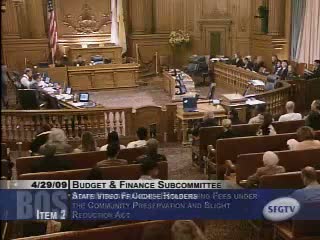
The Budget & Finance Subcommittee voted to send to the full Board an ordinance that would amend the administrative code to establish a fee for state video franchise holders to support public, education and government (PEG) channels.
Supervisor Ross Mercarimi said public access could “go dark” on June 30, 2009 unless the city secures a funding mechanism. Ron Vincent of the Department of Technology told the committee an RFP for operations initially offered at $120,000 drew no responsive proposals and DT plans to reissue the RFP while preparing temporary measures to keep channels running. "We are in support of continued PEG funding," Vincent said, adding that his department will try to keep channels from going dark on July 1.
Budget analyst Harvey Rose summarized estimates showing the ordinance at the maximum PEG rate (3%) could increase PEG-related revenues substantially but noted the Department of Technology's interpretation of state law may restrict the use of PEG fees to capital (facilities and equipment) rather than operating costs. Rose said the city could see a recurring operating gap of roughly $800,000 if PEG fees are limited to capital and cannot be used for operations, and that the department had identified a one-time $120,000 general-fund contribution for the current year.
Deputy City Attorney Cheryl Adams described an existing FCC ruling and a Sixth Circuit interpretation that restrict use of PEG funds for operations under federal cable law; she said the ordinance mirrors state language so that future clarifications or court decisions would determine how the new local fee can be used. "There is a... ruling... that use of PEG funding for operations does constitute a franchise fee," she said.
Public comment filled the chamber: dozens of producers, nonprofit representatives and youth program participants described Access SF programming and training. Access SF executive director Zane Blaney said community programming would suffer without sustained operations funding. Comcast's regional vice president Johnny Giles told the committee Comcast opposed the ordinance as written, saying it imposed an unreasonable pass-through cost on subscribers and warning of legal constraints on spending for operations.
After extended discussion about legal risk, the committee voted to move the ordinance to the full Board with a recommendation; supervisors split over whether to continue the item to obtain additional legal and budget detail but the motion to proceed passed. The Board will now consider the ordinance and the related budget implications; the subcommittee asked the Department of Technology and the mayor’s office for more detailed budget breakdowns before the full Board hearing.