Get Full Government Meeting Transcripts, Videos, & Alerts Forever!
Get email alerts on the Homelessness topic
No spam. Unsubscribe anytime.
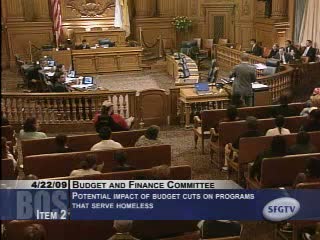
Supervisors hear sharp public opposition to HSA’s proposed homeless-service cuts as agency details FMAP, program reductions
Summary
Human Services Agency presented proposed reductions totaling roughly $3.48 million in homeless services and outlined $30 million in projected FMAP reimbursements; service providers, unions and clients warned that cuts to drop-in centers, daytime shelter access and supportive-service funding would harm vulnerable residents and jeopardize housing investments.
The San Francisco Human Services Agency told the Board of Supervisors’ Budget & Finance Committee on April 22 that it expects roughly $30 million in increased federal Medicaid participation (FMAP) but has not yet budgeted that revenue into the FY09/10 proposal. Meanwhile, HSA laid out proposed homeless-service reductions estimated at about $3,480,000 for next fiscal year, prompting dozens of public commenters to ask supervisors to restore funding.
HSA Director Trent Rohrer said the agency projects about $30,000,000 in increased federal reimbursement for foster care and in-home supportive services and is negotiating with California on how the money will flow. He acknowledged the city still faces a significant general-fund gap and that HSA’s proposed homeless reductions represent about 4% of the agency’s roughly $75 million homeless services budget.
Rohrer walked committee members through specific proposed reductions: elimination of three housing/homeless HSA staff (about $181,780 general fund), an ~18% reduction to Mission Neighborhood Resource Center programs (~$157,000), complete elimination of funding for the Tenderloin Health drop-in center (about $927,000), and reductions of $455,000 achieved by eliminating full 24-hour staffing and moving to reduced daytime staffing at several large shelters. He also described a proposed $800,000 reduction in supportive-housing services achieved by setting a baseline per-unit funding level (presented in the budget as "$18.58 per unit per year"), creating a $2.3 million pool, and using a competitive RFP to reallocate funds where demonstrable need exists.
Rohrer defended the analytic approach: in HSA’s review, housing-retention rates across supportive-housing sites were high (quoted as roughly 90–95 percent) despite wide variation in per-unit service dollars. The $18.58 baseline (the department described it as around the 60th percentile of current per-unit funding) would allow a performance pool so providers with higher-need populations could apply for additional funds through an RFP and competitive scoring process.
Public comment was extensive and united in its concern. Providers, clients and unions said the cuts would destabilize a longtime safety net. Testimony highlighted real-world consequences: clients warned that closing resource centers and eliminating daytime shelter access would push people into the street, spread disease, and increase calls on emergency services. Shelter operators and housing developers argued that supportive services underpin leveraged capital projects and tax-credit investments, so cutting services could jeopardize capital financing and future housing development. "You can't cut Tenderloin Health out completely," said James Ward, a speaker from the Mission, and several other speakers described the Tenderloin and Mission resource centers as culturally specific access points essential to placing people into shelter and housing.
The Supportive Housing Employment Collaborative (SHEC) and other workforce programs warned that cuts would reduce placements and job-training opportunities: "a $114,000 cut will stop us dead in our tracks," said a program representative, describing losses in training slots and staff. Housing providers also cautioned that some subsidies and loan covenants for newly developed supportive housing assume ongoing supportive-service funding.
Rohrer and committee members agreed to continue the conversation. HSA said it would continue the SASH/RFP process and that the final amount of any restorations would depend on how much additional FMAP or other funding is later committed to the city. Rohrer emphasized the department prioritized housing and shelter over drop-in center programming when forced to choose, and said the proposed shelter staffing reductions were based on daytime utilization analyses.
Why it matters: The hearing highlighted the tension between budget constraints and maintaining a complex safety net for people experiencing homelessness. Supporters of funding restoration argued that cuts would save only modest general-fund dollars now while creating longer-term costs and human harm.
What’s next: The board signaled a strong interest in pursuing restorations where feasible and asked the mayor’s office and HSA to report back with clearer dollar figures and timelines for how FMAP or stimulus funds might be applied to preserve essential services.