Get Full Government Meeting Transcripts, Videos, & Alerts Forever!
Get email alerts on the Citywide Nexus topic
No spam. Unsubscribe anytime.
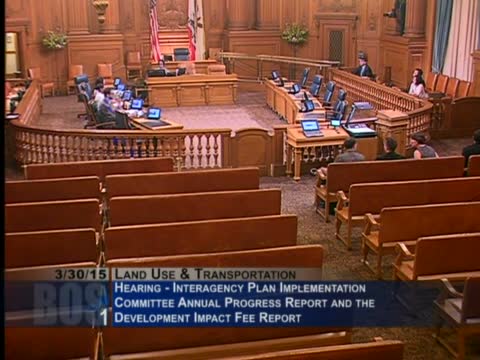
Committee forwards citywide nexus analysis ordinance to full Board; libraries removed from fee expenditures
Summary
The committee voted to forward an ordinance adopting a citywide nexus analysis that updates how development impact fees are calculated and administered, removes libraries as an eligible fee expenditure, and preserves existing fee rates and geographies; the ordinance will go to the full Board with a positive recommendation.
SAN FRANCISCO — The Land Use and Transportation Committee voted to forward an ordinance to the full Board that updates the city’s development-fee framework by adopting a single citywide nexus analysis, staff told the committee.
Kirsten Dissinger of the Planning Department said the citywide nexus study — required by the state every five years — moves the city from multiple area-specific nexus studies to a standards-based approach that covers transportation (streetscapes and bicycles), open space and recreation facilities, and childcare. She told the committee the study "does not look at transit," and that affordable housing is covered by a separate nexus analysis.
While the legislation updates references in the Planning Code to the new citywide analysis and makes administrative clarifications, staff said they did not change fee rates or geographies. The ordinance makes one substantive program change: removing libraries as an eligible expenditure and redirecting roughly the 1% share previously assigned to libraries toward streetscape improvements.
Supervisors asked several clarifying questions during the presentation. Chair Cohen asked how the report could state that the nexus study "assumes that the city will fund 100% of the development based demands for open space" when staff had also described persistent funding gaps; staff explained the nexus cap uses Park Rec’s realistic service level (one square foot of park per person) to ensure developers are not asked to fund more capacity than the city can reasonably provide. Dissinger described constraints that limit impact-fee use to new capacity rather than routine maintenance.
Supervisors also asked whether incentives exist for developers to build on-site childcare; staff said licensing and safety rules are set at the state level and described in-kind agreements as a working strategy (developers providing space rent-free to nonprofit operators, as in a Potrero project example).
With no public comment, a motion to forward the ordinance with a positive recommendation passed on a roll-call vote (Supervisors Kim, Weiner and Chair Cohen voted aye). The ordinance will proceed to the full Board for consideration.