Get Full Government Meeting Transcripts, Videos, & Alerts Forever!
Get email alerts on the Cannabis Policy topic
No spam. Unsubscribe anytime.
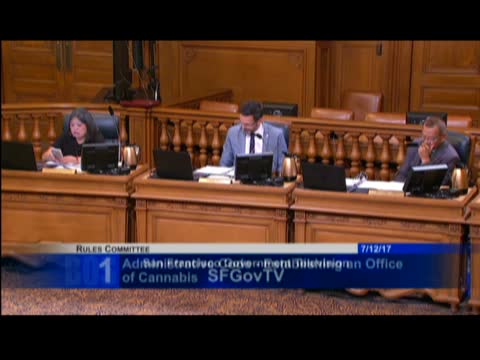
Rules Committee advances ordinance to create San Francisco Office of Cannabis, refers budget to fiscal review
Summary
The Rules Committee on July 12 advanced an ordinance to establish an Office of Cannabis — a centralized, "one-stop shop" for licensing, enforcement triage and state coordination — and sent the proposed $700,000 project budget for fiscal review after accepting amendments extending the cannabis task force through Dec. 31, 2017.
The San Francisco Rules Committee on July 12 advanced an ordinance to create an Office of Cannabis, approving amendments and referring the proposed fiscal package to budget and finance committees for review.
Supervisor Asha Safaei, chair of the committee, said the proposal is intended to streamline city processes following passage of Proposition 64. "This bill really is a housekeeping matter to ensure that San Francisco can comply with Proposition 64," Supervisor Sheehy told the panel, arguing a centralized office would be "more streamlined and less expensive" than a separate commission.
Adam Nguyen, finance and planning director for the City Administrator's Office, described the Office as a centralized resource to "facilitate the licensing process" and to act as a "one-stop shop" that coordinates interdepartmental workflows. Nguyen told the committee the office would "manage the final operating licenses, and that includes issuance, renewal, revocation, and suspension, if necessary," and would handle complaints and be a point of contact for state regulators.
Nguyen outlined a mayoral project budget of $700,000 for fiscal year 2017–18 to fund three positions (a manager, a principal analyst and a management assistant), website/portal development and outreach. The transcript also references "225,000" for website development and outreach; the meeting transcript alternately phrases that figure as "225,000 thousand," which is ambiguous; this article reports the amount as $225,000 per the presenter.
Supervisors pressed Nguyen on interagency roles. Chair Safaei asked how existing Department of Public Health and Planning workflows would fit with the new office; Nguyen said current workflows would largely continue and that the Office would issue the final operating permit after required departmental steps were completed. Supervisor Norman Yee asked who would be the ultimate enforcer if a business sold to minors; Nguyen said inspections would remain with specialized departments and the Office would triage complaints and "coordinate with the police department" and could revoke or suspend permits if violations were substantiated. "If it turns out indeed to have been the case, it is substantiated, sustained that they were selling illegally to minors, then we would revoke or suspend the permit as required," Nguyen said.
Supervisor Sandra Lee Feuer raised concerns about fees and equity for small, community-based operators: "Will adding an additional layer of bureaucracy and cost make it even more difficult for smaller operators to operate in our city?" Nguyen said the office is intended to be lean and efficient and that fees would be proposed to the Board and vetted by the Controller's Office, with the long-term goal of fee-generation rather than ongoing general fund support.
The legislation as amended sets a process for establishing fees (an ordinance by Nov. 1, with a stated intent of revenue neutrality) and extends the city's cannabis task force through Dec. 31, 2017 so it can complete work and provide recommendations. Deputy City Attorney John Givner asked for minor language tweaks after the meeting to allow the City Attorney to remove certain code sections from the published code after the task force sunsets without changing the amendments' substantive effect.
Supervisor Norman Yee moved to accept Supervisor Sheehy's amendments; the committee accepted them "without objection." Yee then moved to send the item to the budget/fiscal committee for a positive recommendation; the Clerk and chair confirmed the measure has fiscal impact and must be heard by a fiscal committee, and the motion to send the budget to those committees was adopted without objection.
The committee did not take a roll-call vote on the ordinance on July 12; actions were advanced by unanimous consent at the Rules Committee level and will be reviewed further in the Board's fiscal committees.