Get Full Government Meeting Transcripts, Videos, & Alerts Forever!
Get email alerts on the Community Development Merger topic
No spam. Unsubscribe anytime.
Community raises transparency and equity concerns over MOCI/OEWD merger and proposed CDBG shifts
Summary
Dozens of community leaders and supervisors at a Budget & Finance hearing urged more transparent process and safeguards after the mayor merged the Mayor's Office of Community Investment into the Office of Economic and Workforce Development and released preliminary Community Development Block Grant recommendations that reallocated funding toward a Neighborhood Markets initiative.
The Budget & Finance Committee devoted its longest discussion to the December 2008 merger of the Mayor's Office of Community Investment (MOCI, formerly MOCD) into the Office of Economic and Workforce Development (OEWD), proposed changes to Community Development Block Grant (CDBG) allocations, and the Neighborhood Marketplace Initiative (NMI).
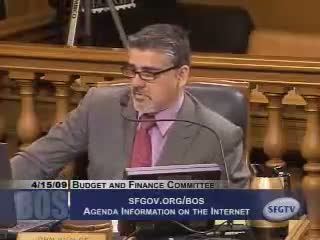
Chair John Avalos opened the hearing describing concern that the reorganization had proceeded with little public input and that the city risked losing a unified community development frame that historically combined affordable housing, public facilities, economic supports and capacity building for community-based organizations (CBOs). Jennifer Entine Matz, deputy director of OEWD, said the merger is intended to align funding streams and reduce redundancy, and she described proposed departmental roles: MOH (Mayor's Office of Housing) would interface with HUD for CDBG compliance, OEWD would lead economic and workforce and manage capital and economic grants, DCYF would administer public services and violence-prevention funds, and a unified annual RFP would be used to solicit CDBG and emergency shelter grant proposals.
Entine Matz and MOCI staff outlined the public RFP schedule (October release, November proposals, months of review including site visits), the Citizens Committee on Community Development (CCCD) review process and subcommittees, and said staff had worked to reduce unexpended capital balances from previous years (staff cited reductions to approximately $3.3 million of unexpended capital funds). She said seven positions had been eliminated as part of consolidation, yielding "over $800,000 in general fund savings" and that the $10,000,000 in HUD dollars estimated for FY09-10 remains proposed for CBO grants.
Public comment was extensive. Pamela David (Haas Fund, former MOCD director) urged that whatever structural changes occur must preserve a genuine community development strategy and leadership, especially to support nonprofit facility capital needs, technical assistance and neighborhood planning. Smaller neighborhood representatives and citywide CBO leaders described deep concern that proposed shifts (including a substantial increase this year for the Neighborhood Marketplace initiative) had been proposed without community vetting and that several CBOs serving immigrant communities faced steep reductions (examples cited by speakers included cuts reported by Chinese Newcomer Service Center and others).
OEWD staff explained some allocation choices: the Citizens Committee separated micro-enterprise assistance (neighborhood- and often ethnically focused services) from small-business assistance (for firms with more than five employees) and used metrics such as cost per business assisted to allocate funds; the Committee reallocated funding in some cases to the City College Small Business Development Center based on that cost-efficiency metric. Staff said preliminary recommendations were published and that March's public hearing generated feedback that the committee then considered before forwarding recommendations to the mayor. Final HUD allocations were expected within about two weeks; OEWD proposed returning to the Board the week of April 29 with an accept-and-spend resolution for approval.
Supervisors pressed for a formal working group that meaningfully includes neighborhood CBOs, and Supervisor Campos emphasized Board oversight tied to Charter processes for formal transfers of positions and appropriations. The City Attorney and budget staff said formal transfers of civil-service positions and reappropriations would trigger notification to the Board and a 30-day period for the Board to disapprove under Charter Section 4.132, and that those transfers were expected to appear in the FY09-10 budget submission (anticipated June 1). Chair Avalos asked OEWD and MOCI to work with supervisors and community members to form a working group; staff agreed.
No final accept-and-spend resolution was acted on at the meeting. The committee asked staff to pursue HUD's final figures and return with a formal accept-and-spend resolution once allocations are finalized and to convene a community working group to shape the broader community development strategy.