Get Full Government Meeting Transcripts, Videos, & Alerts Forever!
Get email alerts on the Juvenile Justice topic
No spam. Unsubscribe anytime.
Board questions timing, inclusiveness and allocations in juvenile justice local action plan
Summary
The committee reviewed the 2009 Juvenile Justice Local Action Plan, heard that aligning department funding aims to protect core services amid cuts, and recorded supervisors' concerns about vetting, representation of vulnerable groups and metrics for accountability before submission to the state.
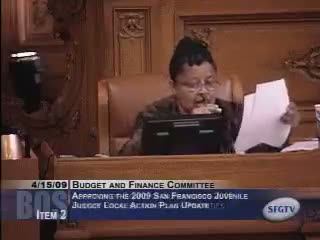
The Budget & Finance Committee took up the 2009 Juvenile Justice Local Action Plan, a state-required document that determines how San Francisco will allocate juvenile justice funding and qualifies the city to draw down JJCPA (juvenile justice crime prevention act) funds.
Brian Chu, Deputy Director of the Mayor's Office of Community Investment, said the plan was developed through the Juvenile Justice Coordinating Council and a broader outreach effort; he told the committee the JJCPA allocation for the coming year is "a little over $2,000,000" and that due to the city's deficit the group anticipated a reduction in total juvenile justice-related funds "from a total of $16,000,000 in the current year to be reduced down to $10,000,000 for 02/2009." Chu said the plan aligns funding streams across JPD, DCYF, MOCI and DPH to avoid duplication and prioritize services for the most vulnerable youth.
Lauren Bell (MOCI) described six program categories used in the plan: alternative education; case management and violence prevention support services (pulled out as a distinct category this year); detention alternatives; detention-based services; diversion; and gender-specific services for young women. Chief Probation Officer Bill Sifferman said the majority of the plan's percentages focus on services provided in the community rather than custody.
Supervisors raised procedural and content concerns. Supervisor David Campos pressed why the plan had not been vetted by the Public Safety Committee given the May 1 state submission deadline and asked whether the plan's generalized risk-definition omitted high-priority constituencies such as undocumented youth and African American youth. Chu and Bell said timing and calendaring constrained a full Public Safety Committee hearing before the submission deadline and that the JJCC deliberately used a behaviorally based, generalized at-risk definition; they said the public process did include community participants and that the guiding principles were intended as philosophical guidance rather than internal departmental directives.
Supervisors also asked about specificity: several asked how the percentage allocations in appendices compared to prior years and whether the RFP and contracting process would ensure performance metrics, geographic sensitivity, and vendor accountability. Bell said the plan intentionally left some program categories broad to allow the RFP process to surface applicant-specific program details and metrics, though she and other staff acknowledged community requests for stronger outcome measures.
Public comment included representatives from immigrant-advocacy groups and youth-serving organizations who urged explicit attention to undocumented youth and to incorporate youth voices, evaluation and training standards. There were also questions about the future location and role of the Community Assessment and Referral Center (CARC); staff said CARC had to vacate a current leased space and that options (community-based sites versus co-location near juvenile probation) were under discussion.
The committee did not adopt the plan at the meeting. Staff said they would pursue options to present the plan to Public Safety on an expedited schedule and that they would return to the committee and the full board as needed to meet the state's May 1 submission deadline.