Get Full Government Meeting Transcripts, Videos, & Alerts Forever!
Get email alerts on the Public Finance topic
No spam. Unsubscribe anytime.
Supervisors push MTA to justify roughly $80 million in work orders; call for audit
Summary
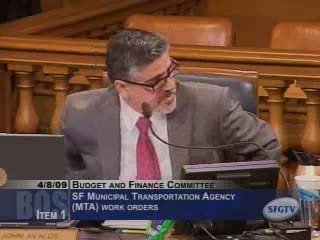
At an April 8 Budget & Finance Committee hearing, supervisors pressed MTA leaders and city departments for clearer justification of roughly $80 million in work orders charged to Muni, urged an independent audit and sought explanations for specific allocations, including 311 and police traffic costs.
Supervisors on the Board of Supervisors’ Budget & Finance Committee used an April 8 hearing to press the San Francisco Municipal Transportation Agency and other city departments for documentation and justification of roughly $80 million in work orders that have been charged to Muni.
The hearing, called by Supervisor Bevan Dufty, centered on whether work orders from other city departments have grown to the point that they are eroding funds voters dedicated to Muni under Proposition A. “I requested this hearing because of concern over the extent to which other city departments are deriving funds that have been allocated by the voters for Muni,” Supervisor Dufty said at the start of the meeting.
Tom Nolan, president of the MTA board, told the committee board members share the concern and said the board is open to an audit. Nolan noted that Prop A had promised about $26,000,000 in new revenues and that the agency has seen significant work‑order growth. “It’s a good time to take a look at every dollar… so we can see what Muni is actually receiving for it,” Nolan said.
Supervisors pressed staff from the city administrator’s office and the 311 call center for specifics about allocations. City administrator staff said improved tracking shows more than 80% of 311 call volume is Muni‑related; using a weighted average for handling times produced a proposed allocation to MTA of about 69%, or roughly $7.7 million in work‑order charges for 311 services. 311’s call center manager said routing and technical options exist but some routing (for example to the State’s 511 system) is not currently configured.
The committee extensively questioned SFPD officials about the unit commonly called the traffic company and about dedicated police overtime on the Third Street (T) line. Committee members highlighted an MTA staff breakdown that showed roughly 87% of certain traffic‑company costs being borne by Muni and asked whether that share is appropriate given revenue flows from moving‑violation fines and other general‑fund receipts. SFPD representatives said the allocation derives from historical arrangements and a functional breakdown that was reviewed with MTA, the mayor’s office, the controller and the city attorney’s office, and that MTA ultimately accepted the percentage.
Controller Harvey Rosenfield told the committee a prior year end accounting item that had been cited during the hearing was a routine posting to complete a budgeted work order, not the sign‑off dispute some supervisors had described. MTA staff said the work orders under discussion are part of budget processes and are not final until the MTA board and the Board of Supervisors complete their budget reviews.
Public commenters representing transit unions, riders and community groups urged the board to “clean the slate” on work orders and recommended a zero‑based review so MTA and the public can confirm that dedicated transit revenues are spent on transit services. Several speakers warned that work‑order growth, if unchecked, will worsen service reductions and fare increases already under consideration to close a roughly $129 million shortfall reported by the agency.
What happens next: MTA staff said the agency would re‑examine questioned work orders and discuss them with relevant departments; multiple supervisors urged an independent audit and said they expect the MTA board to bring back specific plans for review during the budget process.
Timeline provenance: Item introduced at the committee opening; questions and MTA response documented at the start of the hearing and during the MTA staff presentation. The committee emphasized audit options and follow‑up with MTA.