Get Full Government Meeting Transcripts, Videos, & Alerts Forever!
Get email alerts on the Police Budget topic
No spam. Unsubscribe anytime.
Police present constrained FY09‑10 budget; department estimates lower overtime deficit than controller
Summary
SFPD presented its proposed FY09‑10 budget, said overtime management has reduced exposure and estimated an overtime deficit of about $4.4 million (controller projected $6.6M), and described steps to civilianize positions and negotiate work‑sharing with other agencies to find savings.
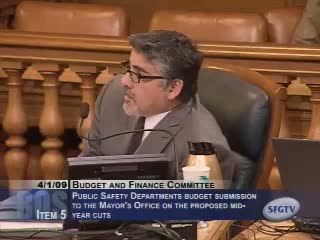
The San Francisco Police Department presented its proposed fiscal‑year 2009—2010 budget and an updated overtime forecast to the Budget and Finance Committee on April 1.
Ken Dukowski, the department—s chief financial officer, said management strategies had substantially reduced overtime hours and costs compared with prior years. He reported the Controller—s Office projected an overtime deficit of roughly $6.6 million; the department—s own projection was near $4.4 million and possibly as low as $4.0 million by year‑end, which SFPD said it could cover within its existing salary budget. The department cautioned that prior overtime budgets were compressed relative to historical use and that baseline budgeting for overtime had been set below recent experience.
Chief Heather Fong and command staff described the department—s $36.53 million reduction target (12.5% plus a 12.5% contingency) and listed proposed savings: reduced uniform salary budget through overtime controls, increased work‑order recoveries (notably an increased MTA/Muni work order for traffic operations), elimination of a COPS grant match opportunity where stimulus rules remove matching requirements, reductions in temporary hires, consolidation of the department print shop, and decreases in on‑call vehicles and cell phones. The department noted it has already cut two academy classes (eliminating 95 positions) earlier in the budget cycle and cautioned that deeper cuts could reduce the sworn staffing levels the City has worked to reach.
Supervisors asked about civilianization (moving administrative functions to civilian staff), Muni and transit safety work orders, and how grant and stimulus funding could be used to support community policing and forensic services. The department said it is pursuing stimulus and grant opportunities, evaluating organizational recommendations from recent reviews, and coordinating with other city agencies to centralize some functions (for example, tow‑desk operations and posting). Chief Fong said bureau chiefs have prioritized recommendations for implementation and that many are scheduled for early completion.
The committee asked department and mayoral staff to continue discussions on contingency reductions and to present detailed proposals for any additional cuts or revenue changes.