Get Full Government Meeting Transcripts, Videos, & Alerts Forever!
Get email alerts on the Fire Budget Overtime topic
No spam. Unsubscribe anytime.
Fire chief says department met midyear reductions but warns deeper cuts could harm services
Summary
Fire Department leaders told the committee they met a 12.5% midyear reduction target (about $6.3M) and outlined a plan to convert static ambulances to dynamic deployment to reduce costs; the chief cautioned further cuts beyond that threshold could require brownouts or closures that would impair operations under Proposition F constraints.
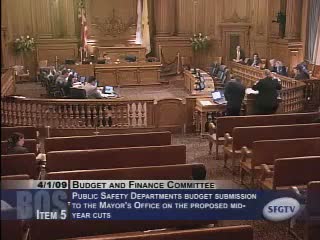
The Budget and Finance Committee heard detailed presentations from the San Francisco Fire Department on monthly overtime and proposed budget reductions.
Chief Joanne Hayes White told the committee the department has restructured ambulance deployment to better match demand and is projecting general‑fund overtime at roughly $24.06 million for the coming fiscal year (a 1% reduction from the current year), largely by converting static 24‑hour ambulances to dynamic 10‑hour shifts, cutting certain non‑labor costs and increasing fee and lease revenue. The chief said the department achieved midyear reductions of about $6.3 million (a 12.5% target imposed by the mayor—s budget office) through layoffs of a small number of positions, reassignment of uniform staff from nonsuppression to field duties, and nonlabor savings.
During the public discussion, the Controller—s Office—s 2004 EMS/staffing study was cited for analytical context: the city—s workload has shifted heavily toward medical calls, the study found, which supports dynamic deployment and triage practices. Chief Hayes White said the department has implemented many of the study—s recommendations (including cross‑training paramedics and engines) and now uses data‑driven deployment to adjust ambulance availability by time of day and weekday.
Supervisors pressed the chief about "brownouts" (temporary unit deactivations) and station coverage. The chief recounted an earlier pilot of rotating brownouts that produced some savings but also administration and response‑time challenges; she reiterated that because of voter‑approved Proposition F and the city—s minimum staffing framework, she and the Fire Commission judged further reductions beyond the identified $6.3 million midyear target to risk operational performance. The department reported continuing efforts to seek additional revenue (for example, potential contracts to provide services at the Presidio) rather than further reduce suppression capacity.
John Hanley, a representative of the firefighters' union Local 798, spoke during public comment urging the Board to preserve suppression and paramedic staffing levels and noting prior union givebacks.
Next steps: the committee requested written follow‑up on which controller recommendations from the 2004 EMS study have been fully implemented and asked staff to return with detailed station‑level workload figures and any updated response‑time data.