Get Full Government Meeting Transcripts, Videos, & Alerts Forever!
Get email alerts on the Budget Projection topic
No spam. Unsubscribe anytime.
Joint report warns of multi‑year budget shortfall up to $746 million if ongoing solutions aren—t adopted
Summary
The Controller, Budget Analyst and Mayor—s budget office presented a joint three‑year projection showing a $438 million gap next year and a potential $746 million shortfall in year three if the city relies on one‑time fixes rather than ongoing solutions.
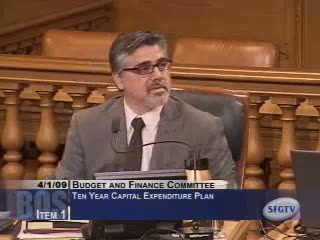
The Budget and Finance Committee reviewed a joint three‑year revenue and expenditure projection on April 1 that projects a structural budget gap unless ongoing fixes are adopted.
City budget staff said the joint report assumes current known revenues and expenditures and highlights a $438 million projected shortfall for fiscal year 2009—2010, rising to $615 million for fiscal year 2010—2011 and to roughly $746 million for fiscal year 2011—2012 under a scenario that treats all near‑term solutions as ongoing. The presenters emphasized that those figures span a range: if the city fills some of the first‑year gap with one‑time solutions, the out‑year shortfalls will grow; if the city adopts ongoing savings or revenue measures now, out‑year deficits will shrink accordingly.
Monique (presenter identified in transcript as Monique Zmuda / Monique Samuda) of the Controller—s Office and colleagues explained key assumptions: receipt of federal FMAP dollars (staff estimated roughly $80 million spanning current and next year), modest property‑tax growth (projected at 1 percent), state funding declines smaller than earlier estimates, and no large, unilateral changes to service levels in the baseline. Staff also assumed retirement contributions would rise substantially (presenters noted a rise from around 5 percent to 9.5 percent, then to 12 and 15 percent in later years for budgeting assumptions) and that health and retirement costs would add materially to the shortfall.
Presenters and supervisors discussed the balance between one‑time and ongoing solutions. The report shows a range of possible outcomes depending on how the city addresses the initial $438 million: pursuing one‑time remedies reduces next year—s gap but pushes costs forward, while a package of ongoing reductions or new revenues would narrow later deficits. The mayor—s office said it is convening a revenue and recovery group to explore a November ballot revenue measure among other options.
Supervisors pressed for more granular data on where layoffs or department cuts might fall and requested a follow‑up balancing exercise and a revenue letter in June that will identify one‑time and ongoing proposals in the mayor—s budget. The committee did not take a vote on any policy action in the hearing; staff will return with revised projections and specific options during the budget process.