Get Full Government Meeting Transcripts, Videos, & Alerts Forever!
Get email alerts on the Budget Deficit topic
No spam. Unsubscribe anytime.
Mayor—s office cites hundreds of millions in shortfall as unions and advocates urge revenue options
Summary
The mayor—s budget office told the Budget & Finance Committee the city faces a multi-hundred-million-dollar general-fund deficit and has asked departments to identify steep reductions; union and community speakers urged the board to pursue new revenue as program cuts threaten public health and housing services.
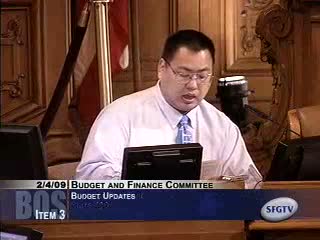
Greg Wagner, deputy director of the Mayor—s Budget Office, told the Budget & Finance Committee on Feb. 4 that the city faces a deep current-year shortfall and that departments were asked to identify budget reductions and revenue options to help close the gap.
Wagner said the city—s preliminary base budget picture showed an estimated deficit of about $575,600,000 before midyear reductions. He said midyear cuts taken earlier this year reduced costs by roughly $115,000,000 but left a substantial remaining gap. Departments were issued guidance to identify a 12.5% reduction target and an additional 12.5% contingency; Wagner described the period now as an "idea generation" phase in which departments and their commissions should propose savings and revenue measures for mayoral review.
The mayor—s office identified department-level levers that could contribute to savings, including administrative and contracting efficiencies in the Department of Public Health, shifting eligible police traffic-management costs to MTA funds, and streamlining administrative functions at Human Services Agency. Wagner said some savings rely on state-level developments and labor negotiations; the budget team is using a placeholder $90,000,000 for potential labor contributions, which assumes employees would forgo negotiated raises.
Wagner warned that the state budget remains a major wildcard. He said the mayor—s office currently assumes roughly $72,000,000 of additional costs tied to state actions in the city—s budget assumptions and that a combination of departmental efforts, revenue proposals and reserve withdrawals could still leave about $177,000,000 of unidentified solutions.
Public commenters urged the board not to adopt deep, across-the-board cuts without pursuing revenue measures. Robert Holland of SEIU Local 1021 said the remaining shortfall would amount to a 25% cut in practice and warned it would have "disastrous" effects on public-health services. "If you say no to a special election, if you say no to additional revenues, then I would say to you, it's irresponsible," Holland said.
Ted Gullickson of the San Francisco Tenants Union opposed proposals to ease condominium conversions, saying such measures would accelerate displacement and remove rent-control protections for many units. Jennifer Friedenbach of the Coalition on Homelessness and other service providers said midyear cuts already inflicted harm and that further reductions would increase demand on emergency services and jails.
Wagner outlined next steps and calendar dates: departments submit budget proposals to the controller on Feb. 21; the mayor—s office will begin cross-departmental decisions on March 1; the controller—s six-month report is expected imminently and may inform revenue projections; and proposed midyear layoffs, if adopted by departments, could take effect May 1. The committee scheduled continued hearings and additional revenue-item calendaring for the following week.
The presentation and public comment left unresolved the combination of cuts, revenue measures and labor concessions the city will adopt. The committee asked the mayor—s budget office and the controller—s office to return with updated revenue and expenditure analysis at the next meeting.