Get Full Government Meeting Transcripts, Videos, & Alerts Forever!
Get email alerts on the Gosolar Sf topic
No spam. Unsubscribe anytime.
PUC reports early success and outreach gaps in GoSolar SF; supervisors demand targeted outreach to low-income and nonprofit sectors
Summary
PUC told supervisors the GoSolar SF program generated 111 applications and roughly 1 MW of installed solar since July 1, but supervisors pressed for stronger outreach to low‑income, environmental‑justice ZIP codes and nonprofit/multiunit housing after limited low-income uptake.
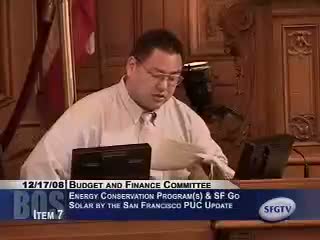
The Public Utilities Commission briefed the Board of Supervisors’ Budget Committee on Dec. 16 about GoSolar SF, the city’s $3 million rooftop solar incentive program. PUC assistant general manager Barbara Hale said the program leveraged state California Solar Initiative and federal tax incentives to reduce solar costs roughly in half for San Franciscans and reported about 1 megawatt of installed capacity and 111 applications from July through November.
Hale outlined discrete residential incentive levels: a $3,000 base payment; $4,000 for using a city-certified installer; $5,000 for environmental-justice or certain low-income customers; and $6,000 for workforce-development installers. A $5,000 low-income adder can be stacked with one of those levels, potentially producing up to $11,000 in city incentives for a qualifying low-income household. PUC also outlined business and nonprofit incentive rules, including $1,500 per kilowatt for some nonprofit owners and a $4,500/kW rate (up to $30,000) for multiunit nonprofit residential buildings.
Supervisors questioned outreach and program rules after PUC acknowledged low‑income uptake lagging relative to non‑low‑income applicants (PUC reported 23 low‑income residential applicants to date). Supervisors and staff said some nonprofit and multiunit housing ownership models (limited liability corporations) and state CSI timing constrain access; PUC said it will pursue targeted outreach, coordinate with the mayor’s office of housing and redevelopment, and seek rule amendments where appropriate.
Workforce and economic development staff described program certification rules for installers participating in the workforce incentive: certified installers must hire at least one GoSolar worker, have workforce workers perform at least 25% of project hours across qualifying jobs, pay at least $15/hour (average ~$17 currently), and generally employ the worker at least 80% time. Staff said hires have come from Haight-Ashbury, Bayview-Hunters Point, Ingleside, Richmond, Mission and other neighborhoods.
Installers and industry advocates told the committee the program has been “wildly successful” for early adopters and that state CSI low‑income components were expected to launch in early 2009, which could boost nonprofits and low-income building access. Supervisors requested follow-up reporting (ZIP-code breakdowns, detailed workforce hiring data and a targeted outreach plan) and set a follow-up meeting in the spring.
Next steps: PUC will provide the requested ZIP-code and workforce demographic data, prepare targeted outreach and consider program rule amendments to enable multiunit and nonprofit participation.